
Trunk comparison: BMW X1 vs Ford Escape


Summary of the Key Differences
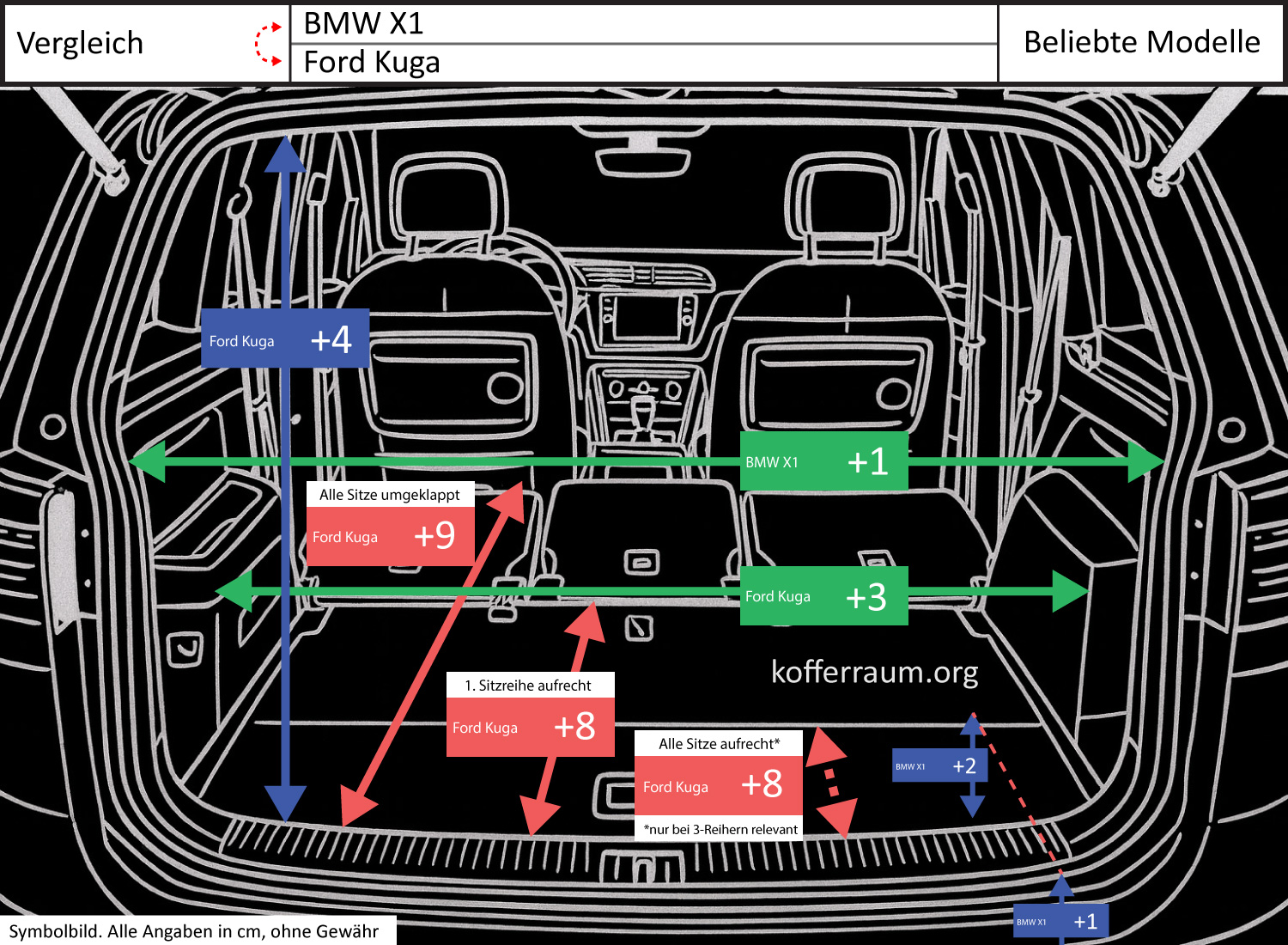
The Ford Kuga offers longer and overall more spacious loading dimensions: with the seats folded down, its trunk is +3.5 in (5%) longer, with the first row upright +3.1 in (9%) longer, and the trunk opening is +1.6 in (6%) higher than the BMW X1. At the narrowest point, the loading width in the Kuga is +1.2 in (3%) larger, while the width of the opening in the BMW X1 is slightly more favorable by +0.4 in (1%).
The loading edge in the BMW X1 is +0.4 in (1%) higher above the ground.
The only significant deviation is the reported depth of the trunk (loading edge to trunk floor): the BMW X1 is +0.8 in (200%) above the Ford Kuga here. Note: the percentage value is very high because the reference size is small; the absolute difference is only 0.8 in.
Impact on Usability
For transporting longer items or larger loads, the Ford Kuga is more practical: the longer loading surface (both with folded seats and with the rear bench upright) plus the higher opening make it easier to load long or bulky parts and increase the usable interior height when loading.
The slightly larger narrowest width slightly improves loading and storing wide items.
The BMW X1 scores with the greater trunk depth (0.8 in more), which — despite the high percentage value — usually only means a small addition of usable space in most practical cases.
The slightly higher loading edge makes lifting heavy items minimally more strenuous but can lead to a slightly deeper interlock between the loading edge and floor when items are stored flat in the trunk. Overall, the BMW X1 differs only marginally in width and opening.
Conclusion: For regular transport of long or bulky items, the Ford Kuga is the more practical choice. The BMW X1 offers a small depth advantage in the cargo area, which usually hardly matters in practice.