
Trunk comparison: BMW X2 vs Ford Escape


Key Differences and Their Impact on Usability
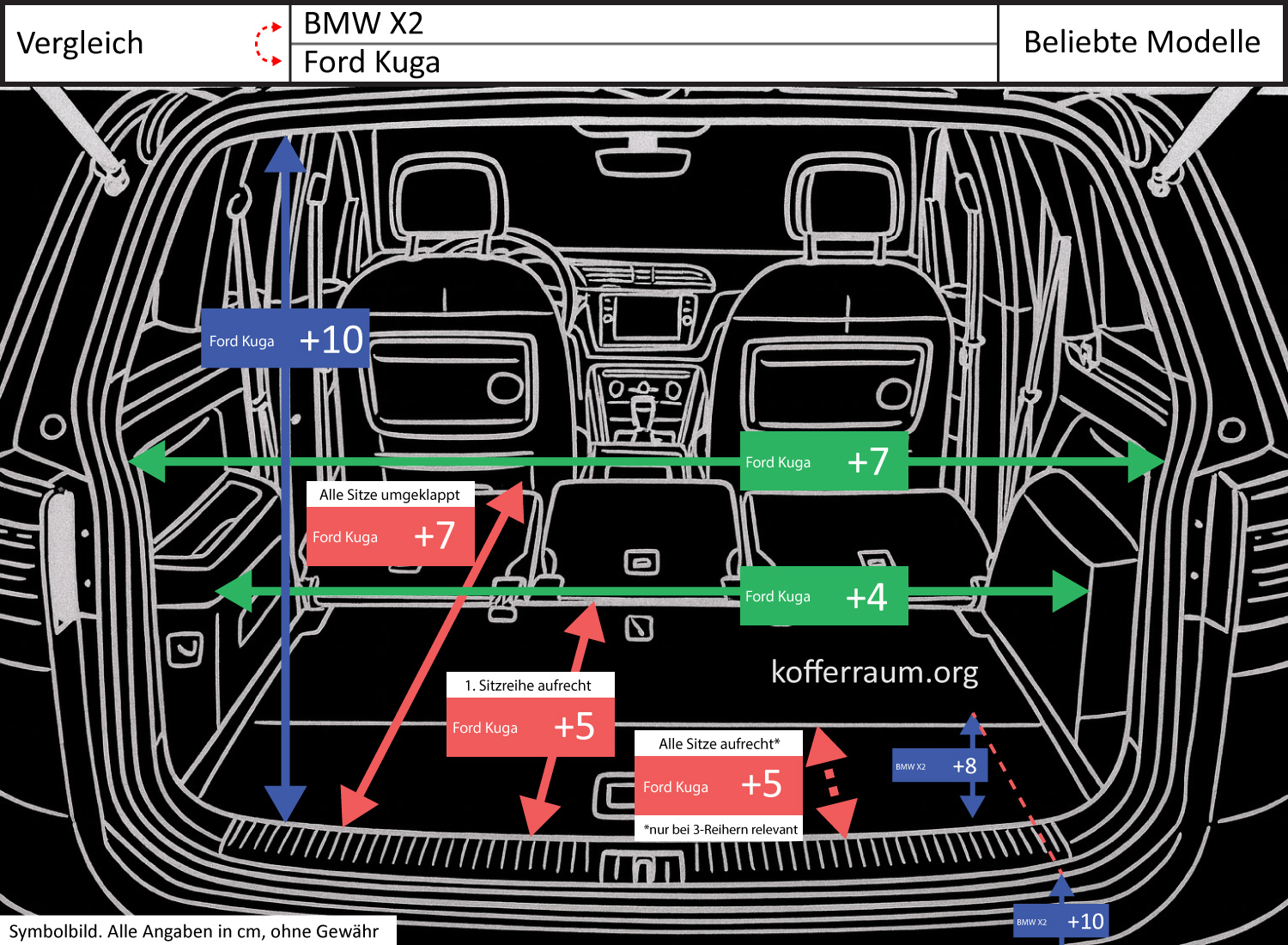
Three differences stand out clearly in the dimensions: The height of the Ford Kuga's trunk opening is 3.9 in (15%) higher than that of the BMW X2. In practice, this means taller items fit more easily through the Kuga's opening, and loading bulky, tall cargo requires less frequent bumping against the opening.
The BMW X2, on the other hand, has a significantly greater depth between the loading edge and the trunk floor: plus 3.1 in (800%). In practice, this means the trunk floor in the X2 lies noticeably lower beneath the loading edge, creating a larger height difference when sliding luggage in.
Heavy cargo must be lifted or lowered more, and side loading is less comfortable. (The very high percentage suggests that the corresponding base measurement in the Kuga is very small.)
Additionally, the loading edge of the BMW X2 is 3.9 in (14%) higher above the ground than that of the Ford Kuga. This increases the effort required to lift suitcases, strollers, or groceries into the X2 and makes loading and unloading less ergonomic, especially for heavy or bulky items.
Besides these notable differences, the Kuga has smaller advantages: it offers slightly more usable length (+2.8 in with folded seats, +2 in with the first row upright) as well as somewhat greater widths at the narrowest point (+1.6 in) and at the trunk opening (+2.8 in).
These smaller differences add up to a somewhat more flexible cargo area in the Kuga but do not offset the fundamental ergonomic disadvantages of the X2 regarding loading edge and floor depth.
Conclusion: For frequent handling of heavy or bulky items, the Ford Kuga is generally more practical due to its lower loading edge and higher opening.
The BMW X2 offers a significantly deeper cargo floor, which in some scenarios may mean more perceived volume or a lower center of gravity, but in practice leads to more effort when loading.