
Trunk comparison: Ford Focus vs Ford Escape
Key Differences
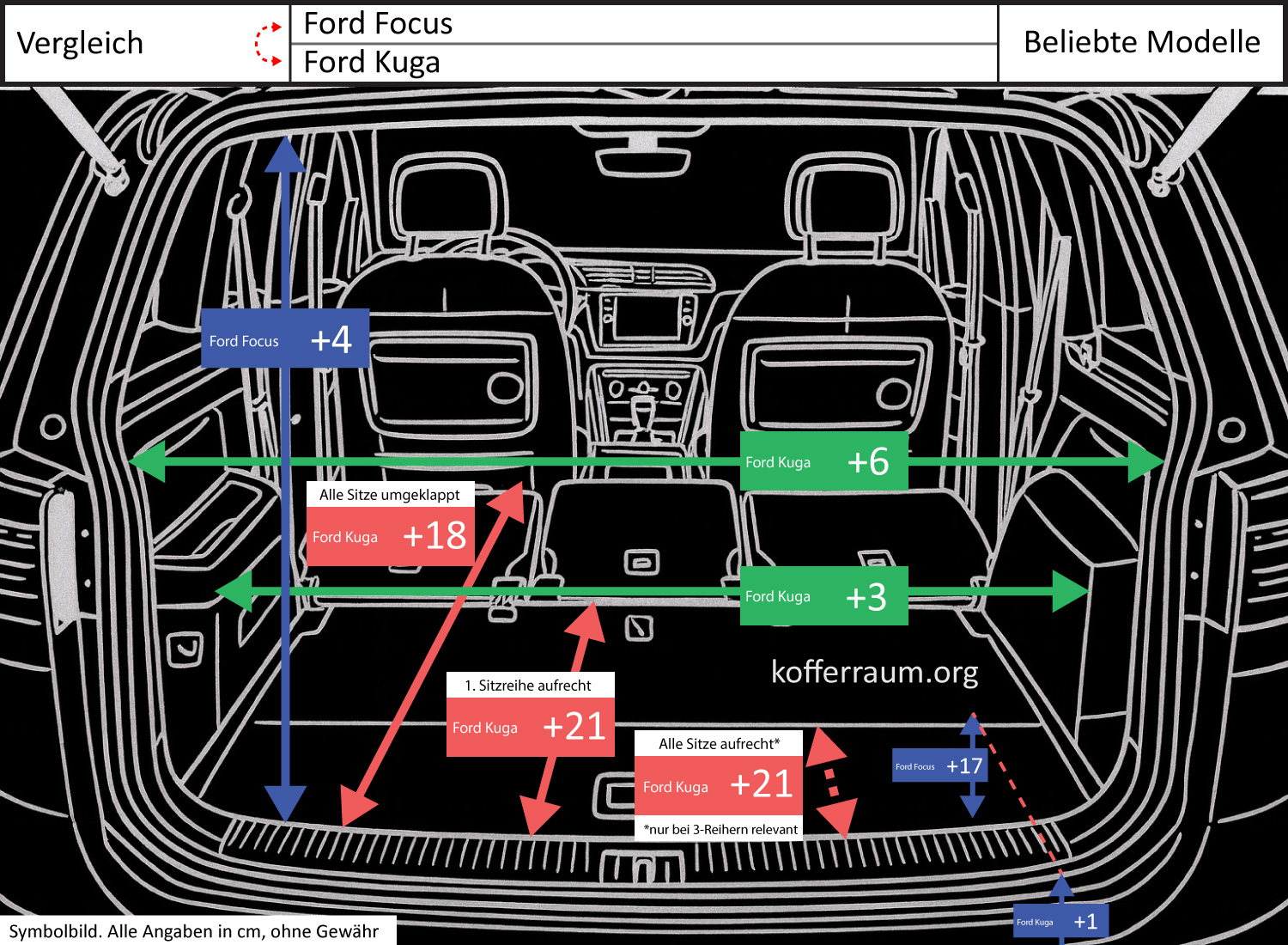
The Ford Kuga offers significantly more usable length in the cargo area: with the seats folded down, the Kuga is 7.1 in (12%) longer, and with the first row upright even 8.3 in (27%) longer than the Focus.
In contrast, the Ford Focus has a significantly greater trunk depth (distance from loading edge → trunk floor): the Focus exceeds the Kuga here by 6.7 in (1700%).
Impact on Usability
The greater cargo length of the Kuga makes it better suited for long items without folding the front seats – e.g., furniture boards, skis, or longer sports equipment are easier to transport in the Kuga. You also benefit from additional cargo space when transporting with folded seats if you need large surface lengths.
The considerably greater trunk depth of the Focus means more vertical space and potentially more usable volume below the loading edge.
This is practical for stacking or sinking luggage but also results in a deeper interior, which can make reaching into the rear area more difficult and affects lifting heavy items over the loading edge.
Smaller differences: The trunk opening of the Focus is 1.6 in (5%) higher — a slight advantage when loading tall items.
The width at the narrowest point (+1.2 in/3%) and the opening width (+2.4 in/6%) are slightly ahead with the Kuga, thus marginally improving fitting wider parts. The loading edge height above the road differs by only 0.4 in (1%), practically negligible.
Conclusion: For transport tasks that primarily require length (long items without folding), the Kuga is the more practical choice. For applications where deeper, stackable space or more volume in the vertical area is important, the Focus may be a better fit.