
Trunk comparison: Ford Escape vs Durchschnitt Subcompact


Key Differences
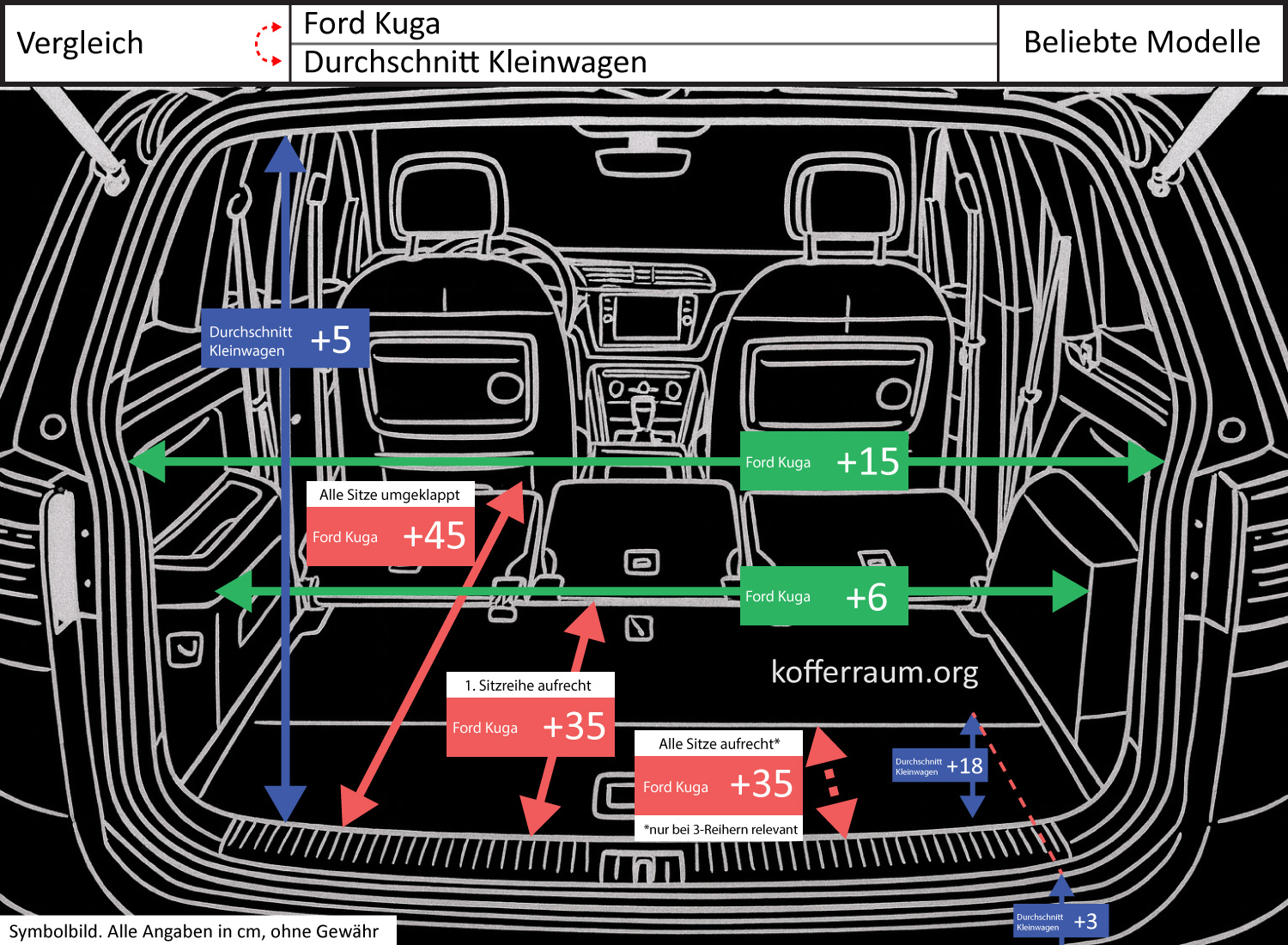
The Ford Kuga offers a significantly longer cargo space with the rear seats folded down: +17.7 in (35%) compared to the average subcompact. Even with the first row of seats upright, the Kuga is noticeably longer: +13.8 in (56%). The width of the trunk opening on the Kuga is larger: +5.9 in (16%).
In contrast, the average subcompact has a significantly greater depth between the loading edge and the trunk floor: +7.1 in (1800%) compared to the Kuga.
Other differences (under 10%) are that the trunk opening of the subcompact is about 2 in higher and the loading edge is about 1.2 in higher above the road; the narrowest width in the Kuga is only about 6% larger.
Impact on Usability
The longer cargo dimensions and wider opening of the Kuga make it clearly better suited for long or bulky items (e.g., furniture parts, long materials, long boxes). The greater cargo length potential with folded seats provides more flexibility for transporting long goods without modifications.
The greater depth (loading edge to trunk floor) in the average subcompact means more vertical volume below the loading edge — this is advantageous when items need to be transported low and stacked or when a deep cargo well is desired.
At the same time, a significantly deeper loading floor can make loading heavy items more difficult because they must be lifted or pulled out from a deeper position in the trunk.
In summary: Those who frequently transport long or bulky loads benefit from the Kuga (longer cargo space, wider opening).
Those who prefer to store lower, voluminous cargo in a deep cargo well have an advantage with the average subcompact. Small differences like opening height (+2 in) and loading edge height (+1.2 in) have only marginal practical effects.