
Trunk comparison: Ford Escape vs Durchschnitt Wagon


Quick Overview of Cargo Volume
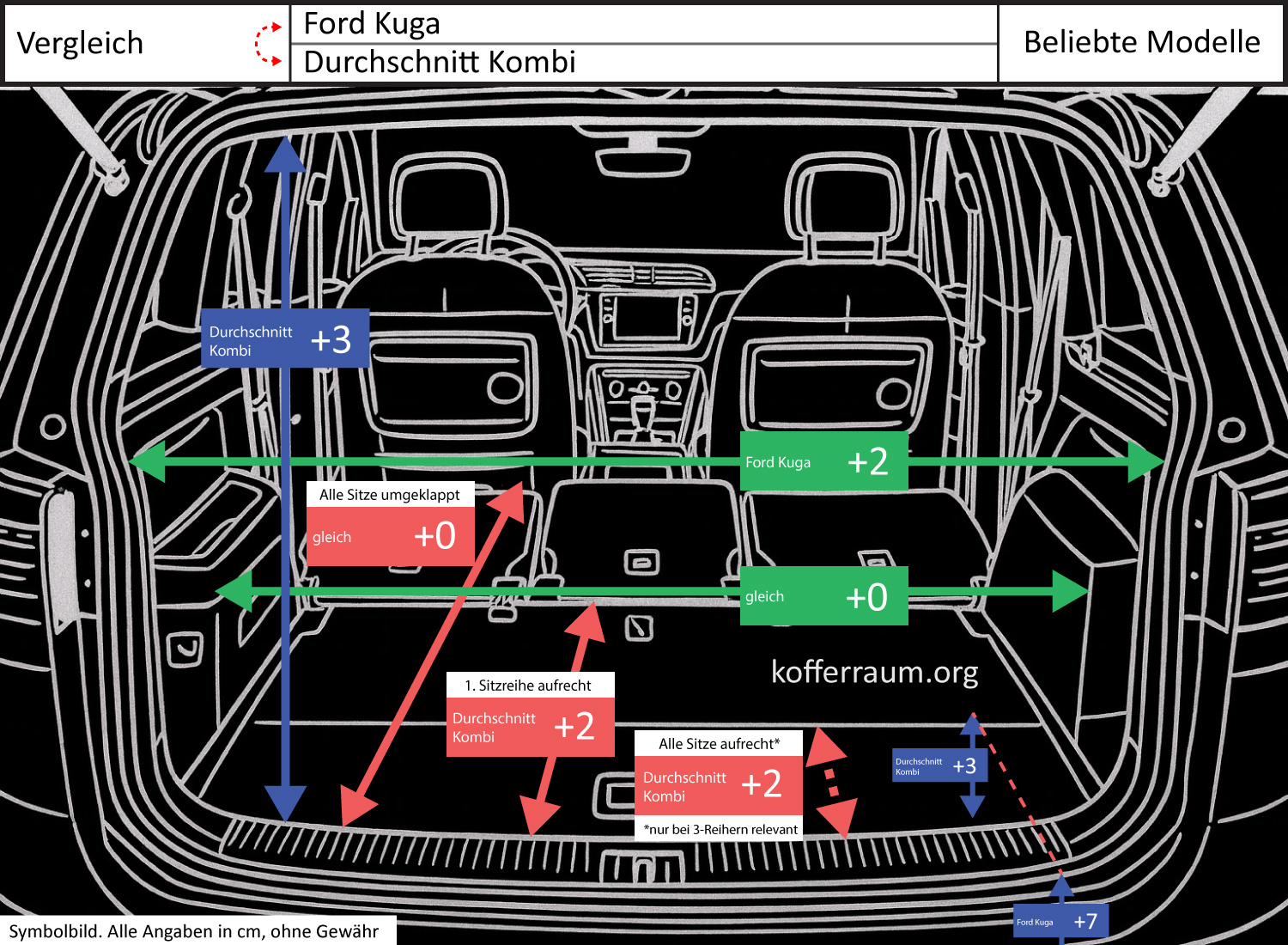
When all seats are folded down, the Ford Kuga and Average Wagon offer the same cargo length. With the front row upright, the Average Wagon is only slightly longer (+0.8 in / 2%). The width at the narrowest point is the same, the width of the trunk opening is slightly larger on the Kuga (+0.8 in / 2%), and the opening height is slightly higher on the Average Wagon (+1.2 in / 4%). These differences are minor and hardly noticeable in everyday use.
Key Differences and Their Impact on Usability
The comparison reveals two significant differences that clearly affect daily usability: the trunk depth and the height of the loading edge. - The trunk depth (loading edge to trunk floor) is significantly greater on the Average Wagon:
. Practical implications: The Average Wagon offers considerably more usable depth and thus better capacity for long or stacked items. Items lie deeper and can be stored more stably; however, reaching deeply placed cargo further inside can be somewhat less comfortable. - The loading edge of the Ford Kuga is higher:
above the road surface. Practical implications: The higher loading edge requires more lifting effort when loading heavy items and makes sliding in furniture or boxes a bit less convenient. As an advantage, the higher loading edge usually provides greater ground clearance and better protection against potholes or road water.
Conclusion — Which Usage Fits Which Vehicle?
For regular loading of heavy or bulky cargo, the Average Wagon is overall more practical: deeper loading floor and lower loading edge make loading and unloading easier and increase usable volume. The Ford Kuga offers comparable loading length and a marginally wider opening but scores with a higher loading edge (more ground clearance), which can be advantageous for driving on uneven terrain or when some extra underbody protection is needed.