
Trunk comparison: Ford Escape vs Hyundai Elantra GT Wagon

Key Differences
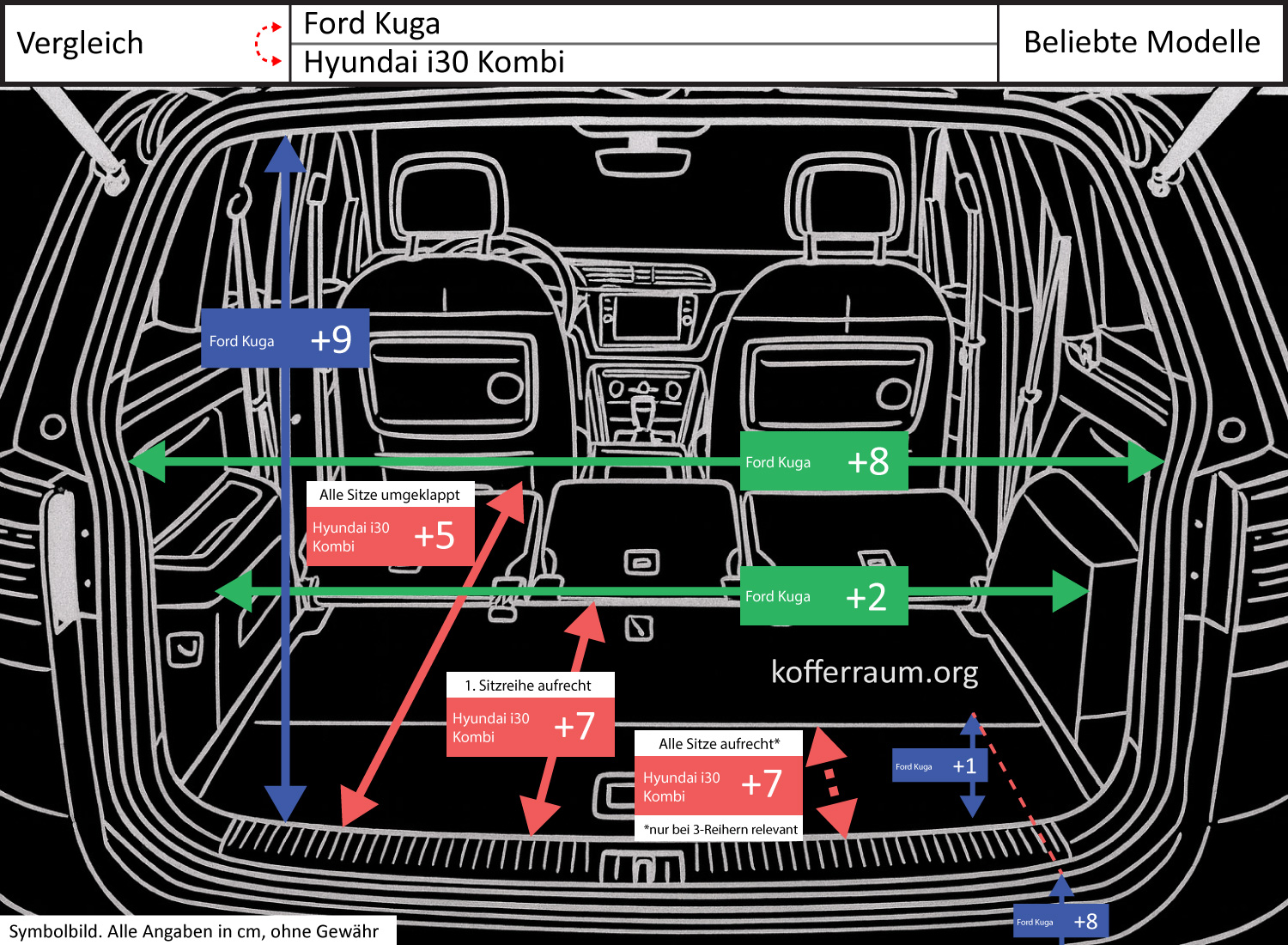
The Hyundai i30 Wagon offers a slightly longer loading length: with the seats folded down, the trunk is 2 in (3%) longer, and with the first row of seats upright, it is 2.8 in (7%) longer than in the Ford Kuga.
The Ford Kuga, on the other hand, has several advantages in opening and accessibility: the height of the trunk opening is 3.5 in (13%) larger, and the loading edge is 3.1 in (13%) higher above the ground than in the i30 Wagon.
Other, smaller differences include a 0.4 in (0%) greater depth (loading edge to trunk floor) in the Kuga, a 0.8 in (2%) wider width at the narrowest point, and an 3.1 in (8%) wider trunk opening width in the Kuga.
Impact on Usability
The longer loading length of the Hyundai i30 Wagon makes it more practical for very long, flat-loadable items like laminate flooring, long furniture parts, or skis – those few centimeters can make the difference between fitting and not fitting when lengths are tight.
The Ford Kuga is better suited when loading taller or bulkier items: the larger trunk opening height allows for taller vertically standing cargo, and the wider opening makes maneuvering wider parts easier.
At the same time, the higher loading edge in the Kuga is a disadvantage: heavy or awkward loads must be lifted higher, making loading and unloading more strenuous and more difficult for one person.
The slightly greater depth and width in the Kuga only marginally improve handling; they are useful but not as decisive as the longer loading lengths of the i30 or the significantly higher opening and loading edge of the Kuga.
In summary: For long, flat-loadable items, the Hyundai i30 Wagon is the more practical choice. For tall or bulky cargo as well as wider parts, the Ford Kuga offers advantages in the geometry of the opening, albeit with the drawback of higher lifting effort due to the higher loading edge.