
Trunk comparison: Ford Escape vs Mercedes Benz GLB

Key Differences
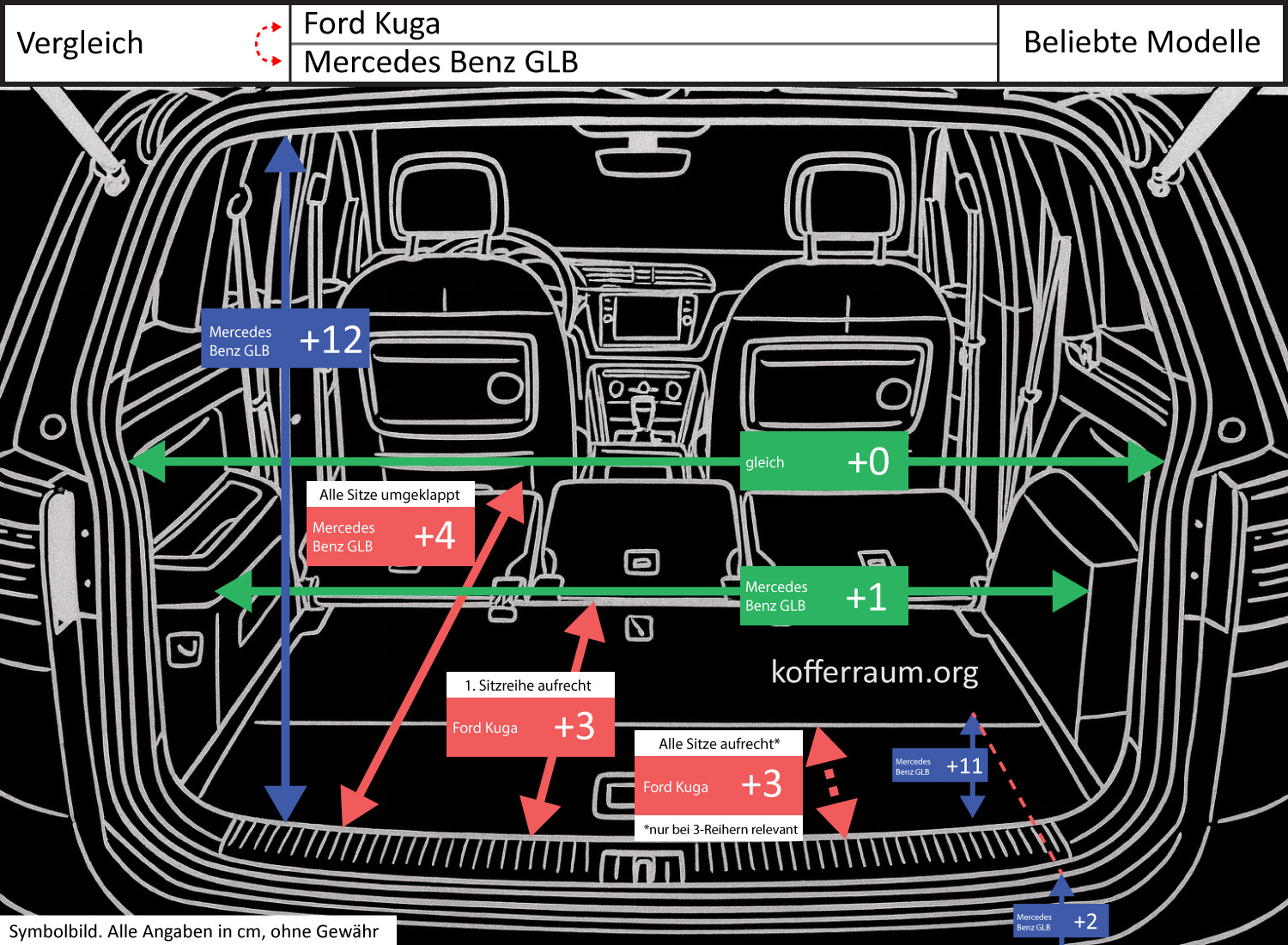
The biggest differences concern the vertical dimension of the cargo area: The Mercedes-Benz GLB has a significantly higher trunk opening (+4.7 in, +16%) and a much greater depth between the loading edge and trunk floor (+4.3 in, +1100%) compared to the Ford Kuga.
All other differences (trunk lengths at different seat positions, loading widths, loading edge height above the road) are within single-digit percentages and thus negligible.
Impact on Usability
The higher trunk opening of the GLB makes it easier to load tall or bulky items (e.g., large boxes, furniture parts, strollers) because more vertical clearance above the loading edge is available.
The significantly greater depth between the loading edge and trunk floor increases the usable interior volume vertically and allows better stacking or standing of taller loads in the cargo area.
At the same time, the greater depth has a practical consequence: items lie further below the loading edge in the GLB, meaning that when loading heavy items, the placement and handling angles are somewhat different than with the shallower floor of the Kuga.
The loading edge of the GLB is only slightly higher above the road (+0.8 in), which minimally increases the effort required when lifting.
Overall, this means: the GLB is better suited for tall and bulky items as well as stacking, while the Kuga remains more comfortable for quick loading and unloading of flat, heavy items due to the shallower floor depth.
Summary
For transport tasks requiring a lot of height or when interior height and stackability are important, the GLB is clearly advantageous.
For frequent lifting/carrying of heavy, flat items, the Kuga may be more practical due to the shallower floor depth. Differences in length and width are too small to significantly affect everyday usability.