Trunk comparison: Ford Escape vs Renault Austral

Key Differences and Implications for Usability
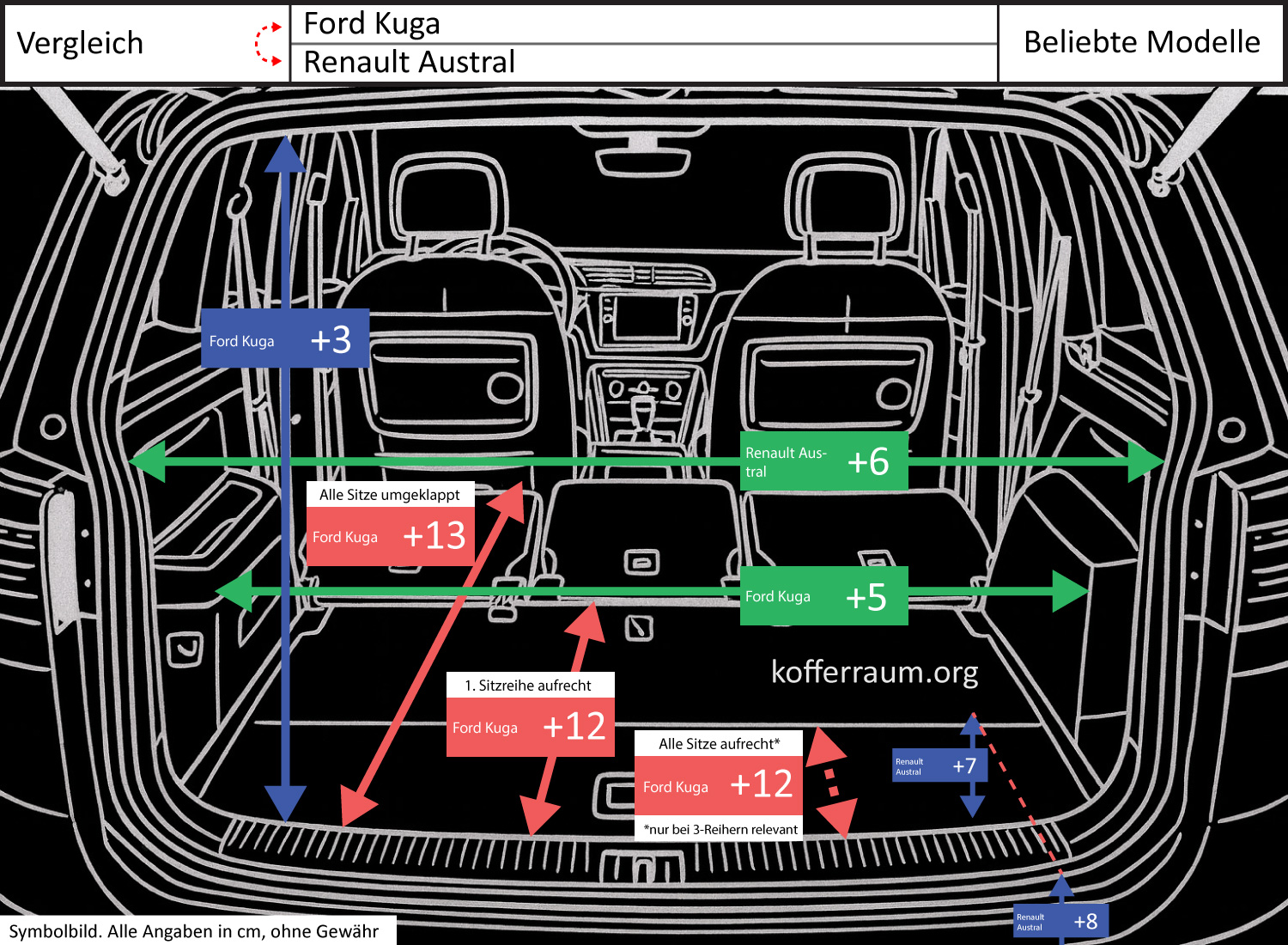
The Ford Kuga offers a +4.7 in (14%) longer cargo floor with the rear seats upright than the Renault Austral.
Specifically, this means long items like skis or poles can be transported better in the Kuga without folding down the rear seats. In the Austral, folded seats or angled items are more often necessary to achieve comparable loading lengths.
The Renault Austral has a significantly deeper interior bay: the depth (loading edge to trunk floor) is +2.8 in (700%) higher than in the Kuga. Combined with this, the loading edge of the Austral is +3.1 in (11%) higher above the road.
Practical consequence: items must be lifted higher to load into the Austral, but they lie lower inside the trunk.
This can make storing bulky, tall objects more difficult (due to the higher loading edge and reduced effective opening height), but offers more "seating height" in the cargo area, so heavy or bulky loads lie more stably and deeper once inside.
Other, smaller differences: When all seats are folded down, the Kuga is +5.1 in (8%) longer (no emphasis needed), the Kuga's trunk opening is +1.2 in (4%) higher, the narrowest interior width in the Kuga is +2 in (5%) wider than the Austral's, while the trunk opening width in the Austral is +2.4 in (6%) larger.
In practice, this means the Austral offers a slightly wider opening for loading large boxes, the Kuga has a bit more space inside at the narrowest point and clearly the longer cargo floor with upright seats.
Conclusion: For transport tasks involving long items with seats upright, the Ford Kuga is more practical.
For deeper, interior cargo and somewhat wider loading openings (with a simultaneously higher loading edge), the Renault Austral is better suited — but requires more physical effort when lifting items into the vehicle.