
Trunk comparison: Ford Escape vs Seat Tarraco


Key Differences
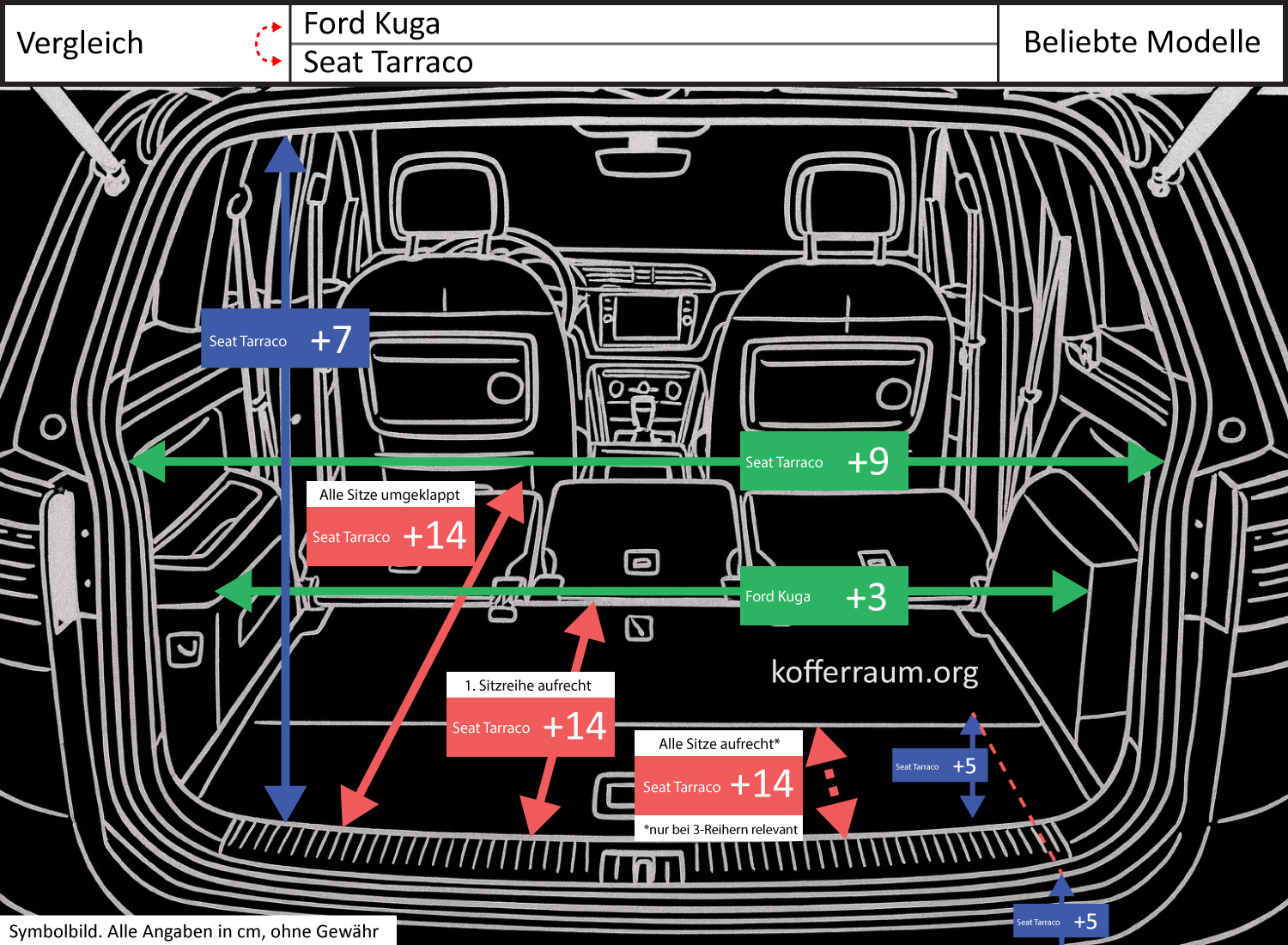
The measurements show several deviations, two of which are particularly significant: The SEAT Tarraco offers
than the Ford Escape. Additionally, the trunk depth (loading edge to trunk floor) in the Tarraco is
. Smaller differences, below the 10% threshold, include a 5.5 in (8%) longer storage space with the seats folded down in the Tarraco, a 2.8 in (9%) higher trunk opening, and a 2 in (7%) higher loading edge in the Tarraco; the Escape is about 1.2 in (3%) wider at its narrowest point, and the Tarraco's trunk opening is approximately 3.5 in (8%) wider.
Impact on Usability
The 14% longer cargo area with the first row of seats upright makes the Tarraco more practical when passengers need to remain in the back: longer items (e.g., skis, long moldings, furniture parts) can be transported more easily behind the first row. This also increases everyday usability when fully occupied and transporting bulky cargo simultaneously. The significantly greater trunk depth in the Tarraco means more usable volume below the loading opening. Smaller or flat items can be stored further down, improving organization and cargo capacity. This advantage can be somewhat offset by the slightly higher loading edge (≈2 in): heavy lifting requires a bit more effort because the loading edge is higher above the road. Smaller differences have less impact: the slightly greater minimum width of the Escape makes it easier to fit wide boxes or crates, while the wider trunk opening of the Tarraco simplifies loading and unloading large, flat items. Overall, the Tarraco is more practical for elongated or volume-intensive cargo tasks, while the Escape scores slightly in maximum pass-through width at the narrowest point.