
Trunk comparison: Ford Escape vs Skoda Karoq

Key Differences
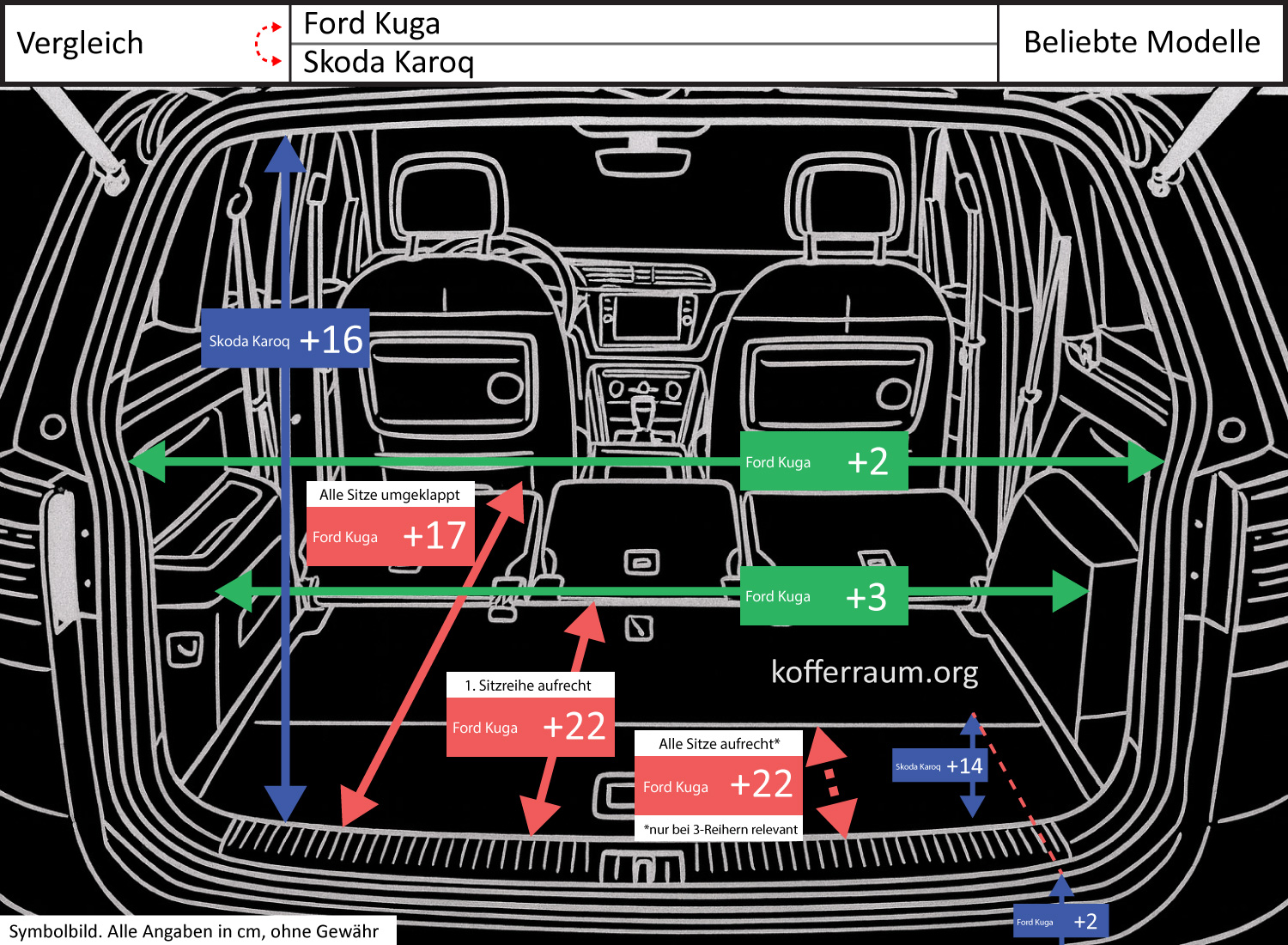
The Ford Kuga offers a 6.7 in (11%) longer cargo area with the rear seats folded down than the Škoda Karoq, and with the front seats upright, it even has a 8.7 in (29%) longer trunk depth.
In contrast, the Škoda Karoq has a 6.3 in (21%) higher trunk opening as well as a significantly greater depth between the loading edge and the trunk floor – here the Karoq is 5.5 in (1400%) deeper.
Smaller differences: the loading edge of the Kuga is 0.8 in (3%) higher, the narrowest width of the Kuga is 1.2 in (3%) larger, and the opening width of the Kuga is 0.8 in (2%) wider.
Impact on Usability
The greater usable length of the Kuga (each +11% and +29%) makes it better suited for long, flat, or bulky items such as slats, furniture parts, skis, or long boxes – both with folded seats and when using the rear seats.
The slightly greater width at the narrowest point and the minimally larger opening width additionally support loading longer items, but only marginally.
The Karoq, on the other hand, is better suited for tall or bulky cargo: the significantly higher trunk opening and the much greater depth between the loading edge and floor make it easier to load tall items and create more space in the vertical dimension.
This makes the Karoq more practical for suitcases, stacked boxes, or bulky items limited by height.
Conclusion: For length-oriented loading tasks and longer items, the Ford Kuga has clear advantages; for tall or bulky cargo and easier handling during loading, the Škoda Karoq is the more practical choice. Smaller differences in loading edge and width are usually negligible for everyday usability.