
Trunk comparison: Ford Escape vs Volvo XC40


Key Differences (>10%)
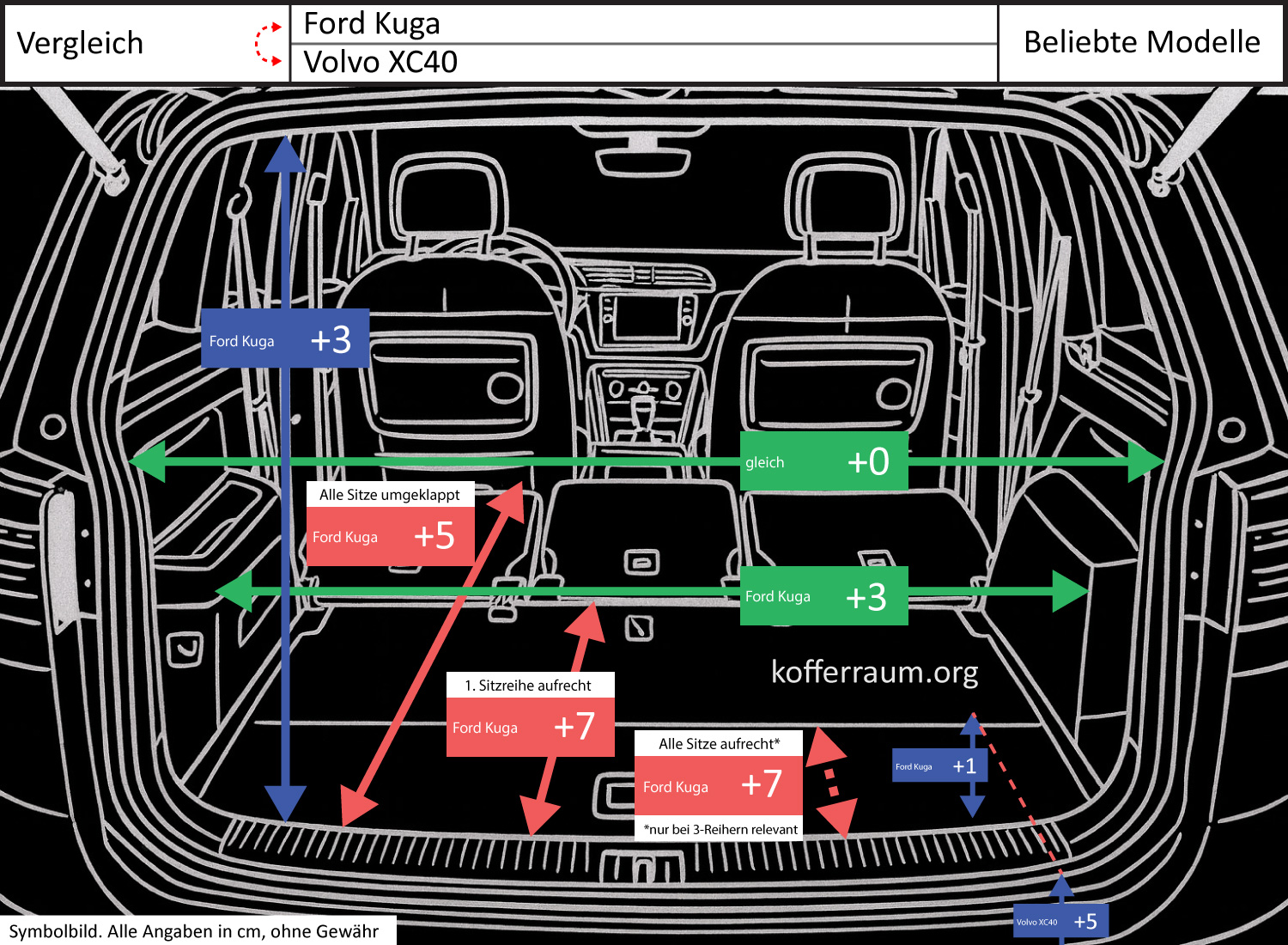
There are no measured differences between the Ford Kuga and Volvo XC40 greater than 10%. All stated deviations range between 0% and 8%, thus below your specified threshold of 10%.
Differences and Impact on Usability
Despite the lack of large percentage deviations, the values show that the Ford Kuga is overall slightly more practical for loading purposes.
Specifically, the Kuga offers a cargo space length that is 2 in (≈3%) longer with the seats folded down and 2.8 in (≈8%) more length with the first row upright; this makes storing longer items like skis or longer boxes somewhat easier.
The height of the trunk opening is 1.2 in (≈4%) larger in the Kuga, allowing slightly taller items to fit more easily. The depth (loading edge to trunk floor) is practically the same with +0.4 in, so there is no relevant impact here.
The width at the narrowest point is 1.2 in (≈3%) greater in the Kuga, while the width of the trunk opening is the same in both models; this means very wide loads fit equally well at the opening, but the Kuga has a bit more room inside where it gets tighter further back.
The loading edge of the Volvo XC40 sits 2 in (≈7%) higher above the road than the Kuga — this makes lifting heavier or bulkier items into the XC40 noticeably more strenuous, with the Kuga being ergonomically more favorable here.
In summary: None of the deviations exceed 10%, so the differences are only slightly noticeable in many everyday situations.
However, for users who frequently load longer or somewhat bulkier items or value a lower loading edge, the Ford Kuga is practically superior. Those primarily carrying normal luggage or shopping bags will hardly notice a difference in daily use.