
Trunk comparison: Ford Escape vs Volvo XC60


Key Differences (Summary)
None of the stated differences exceed 10%. So, there is no characteristic that is clearly dominant (>10%).
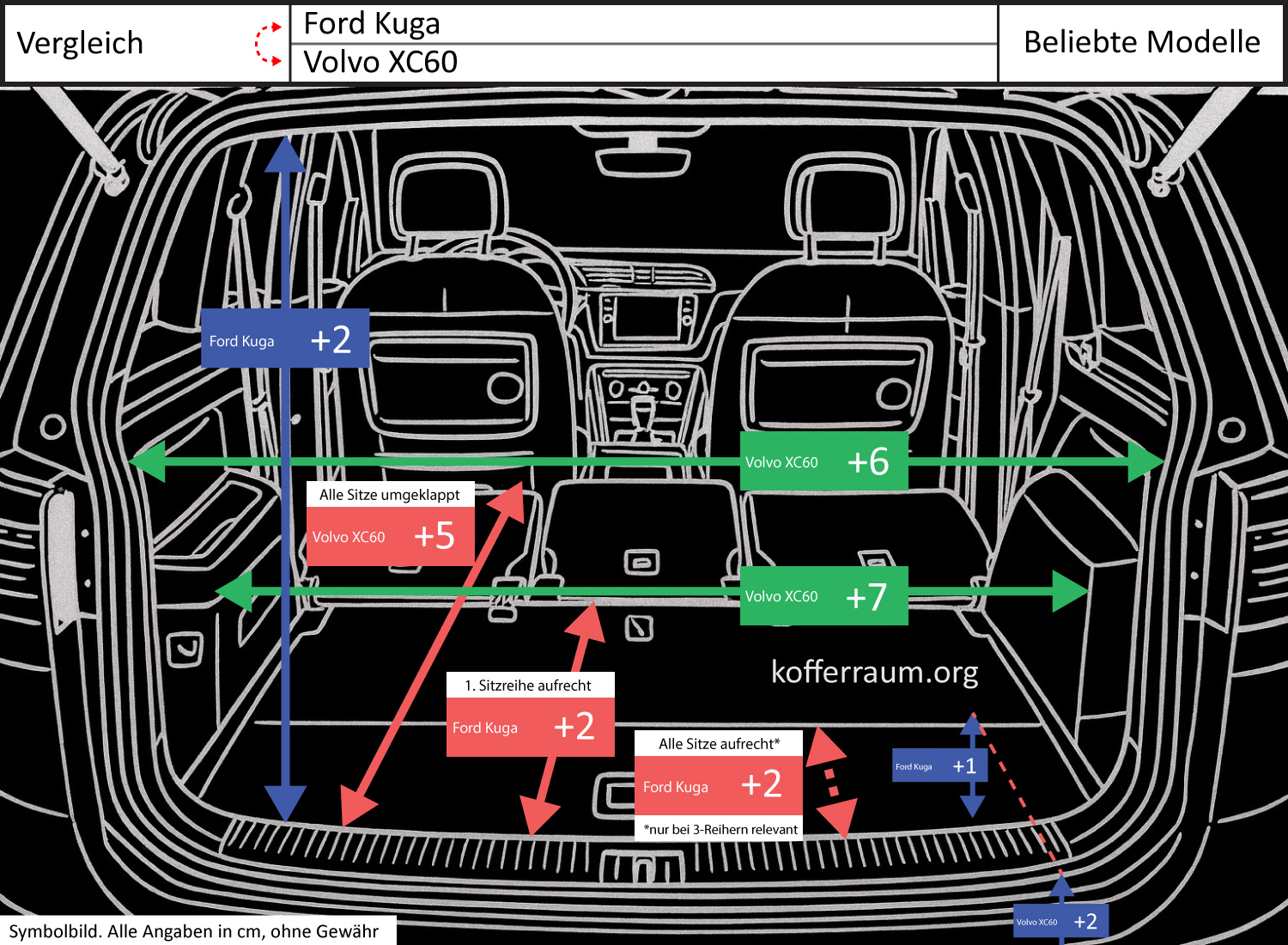
The largest relative deviations are still noticeable: The Volvo XC60 offers a cargo length that is 2 in (≈3%) longer with the rear seats fully folded down, and it is 2.8 in (≈7%) wider at the narrowest point of the trunk; the opening itself is 2.4 in (≈6%) wider on the Volvo.
The Ford Kuga, on the other hand, has a cargo length that is 0.8 in (≈2%) longer with the first row of seats upright, a trunk opening that is 0.8 in (≈3%) higher, and a depth that is 0.4 in (≈0%) greater; however, the loading edge of the Volvo is 0.8 in (≈3%) higher above the ground than that of the Kuga.
What impact do these differences have on usability?
- Width and pass-through: The Volvo XC60 is +2.8 in wider at the narrowest point and +2.4 in wider at the opening. This makes the XC60 noticeably more practical for wide luggage (large suitcases, strollers sideways, wide boxes) and facilitates loading and unloading bulky items.
- Length with folded seats: With the seats folded down, the XC60 gains +2 in of cargo length. This helps to accommodate longer items (e.g., slats, skis inserted) somewhat more easily, but the advantage is rather small.
- Opening height and loading edge: The Kuga has a 0.8 in higher opening, which slightly eases inserting tall items; at the same time, the loading edge on the Volvo is 0.8 in higher above the ground, so a bit more height must be overcome when loading — this can be noticeable when lifting heavy items but is not dramatic.
- Depth (loading edge to trunk floor): The difference of 0.4 in is negligible and has no relevant practical impact.
Practical conclusion
In practice, the differences are moderate. If you regularly transport wide or bulky loads, the significantly greater width of the Volvo XC60 speaks in its favor.
For users who pay attention to a slightly higher opening and a marginally lower loading edge height (easier lifting from the curb), the Ford Kuga is minimally more comfortable. Overall, the deviations are small enough that other factors (price, equipment, driving behavior) are likely to be more decisive when choosing.