
Trunk comparison: Ford Escape vs VW ID.3
Key Differences
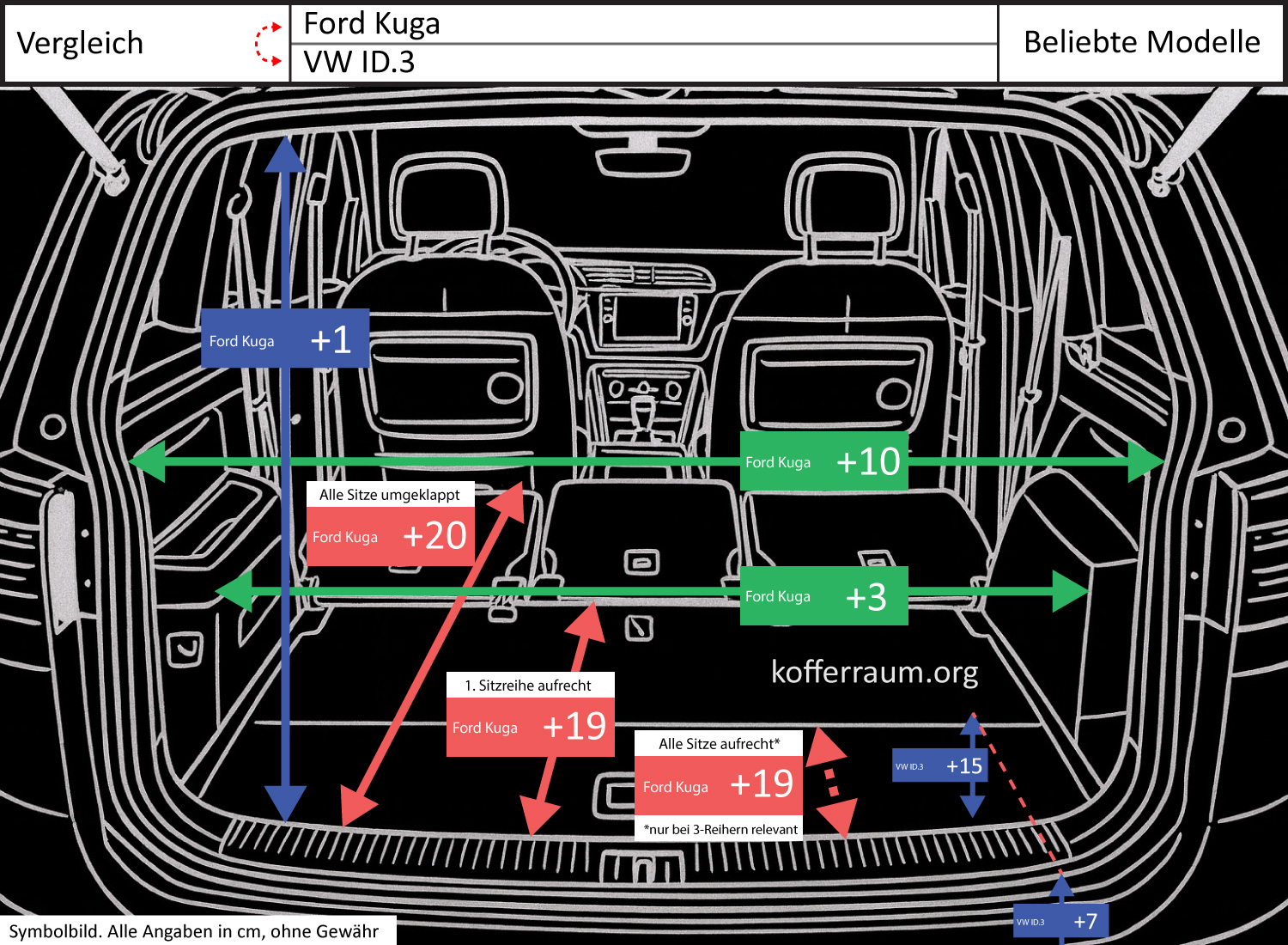
The Ford Kuga offers a significantly longer cargo area with the seats folded down: +7.9 in (13%) compared to the VW ID.3. Even with the first row of seats upright, the Kuga's cargo length is +7.5 in (24%) greater.
Conversely, the vertical dimension differs: the VW ID.3 has a significantly greater depth between the loading edge and the trunk floor, namely +5.9 in (1500%) compared to the Kuga.
Impact on Usability
The longer cargo area of the Kuga (both with folded seats and normal seat setup) makes it more practical for long items like slats, skis, furniture parts, or long boxes – such items can be stored flatter and often without tilting.
For users who regularly transport longer loads, the Kuga is therefore more comfortable in everyday use.
The significantly deeper floor of the ID.3 relative to the loading edge means that loaded items sit deeper in the trunk. This offers advantages in securing cargo and with tall loads (they protrude less upward) and can enhance the sense of volume.
At the same time, this usually results in higher effort when lifting items over the loading edge, because the ID.3's loading edge is somewhat higher (independent of the >10% criterion).
For heavy, bulky items, lifting over the loading edge is therefore easier with the Kuga, while the ID.3 is better suited if you prefer to sink items “deeper” and thus more stably into the cargo space.
Summary
For length and flexibility when transporting long items, the Ford Kuga is advantageous. For lower, more stable loading and better use of interior height, the VW ID.3 scores thanks to its significantly deeper floor position.
The choice depends on whether you more often transport long goods (Kuga) or cargo that is stably sunk into the floor/highly stackable (ID.3).