
Trunk comparison: Ford Escape vs VW Passat Wagon
Key Differences
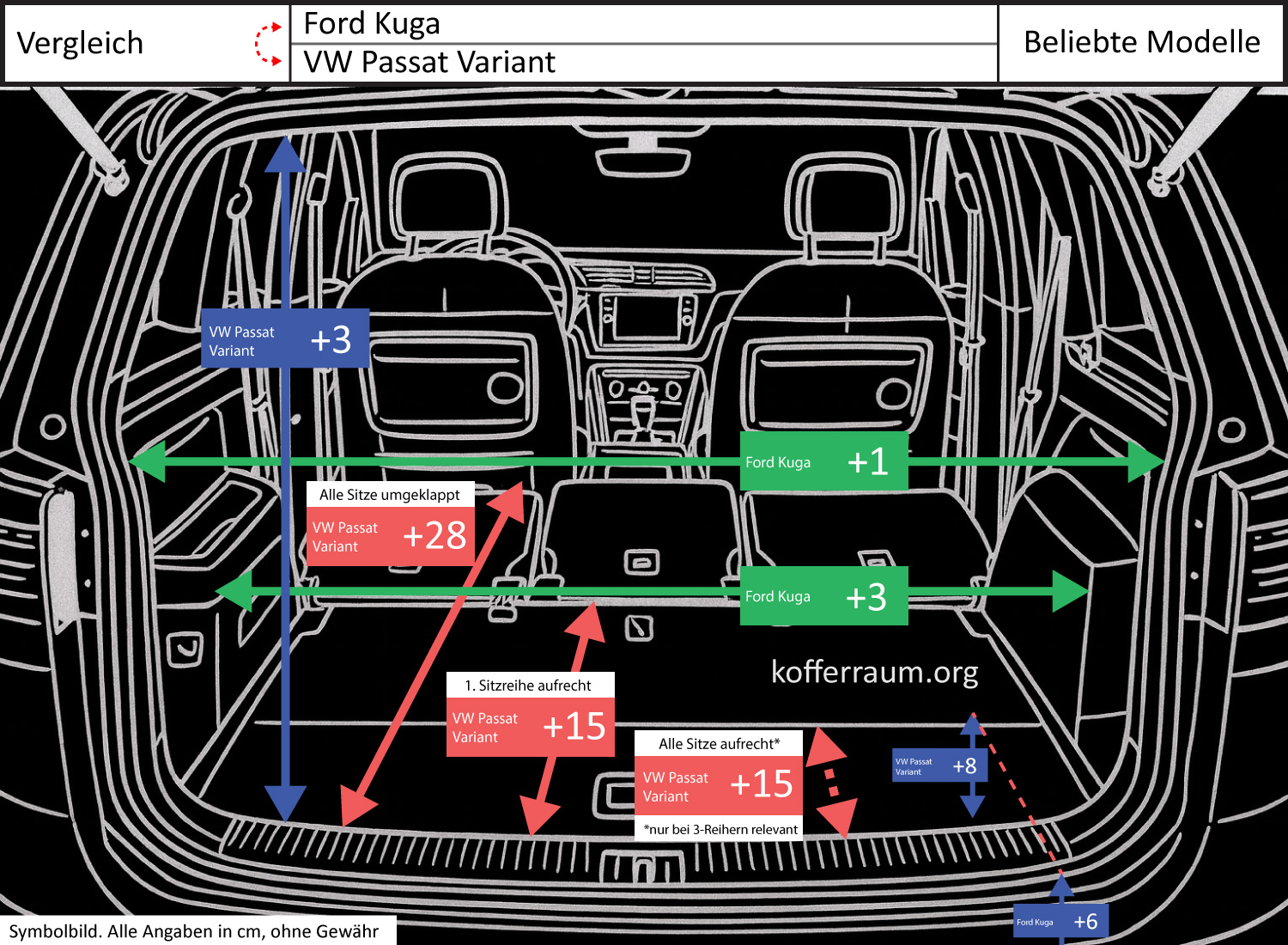
The biggest differences concern the cargo lengths and the depth of the trunk:
- With the seats folded down, the VW Passat Wagon is 11 in (≈16%) longer than the Ford Escape.
- With the first row of seats upright, the VW Passat Wagon is 5.9 in (≈15%) longer than the Ford Escape.
- The depth of the trunk (loading edge → trunk floor) is 3.1 in (≈800%) greater in the VW than in the Ford Escape.
Impact on Usability
These differences lead to clearly different strengths in practical use:
- More usable length in the Passat means better suitability for long items (boards, furniture parts, skis). With the seats folded down, the Passat offers significantly more pass-through length; even with normal seating, there is more space for suitcases or bulky cargo.
- The significantly greater depth in the Passat creates more space below the loading edge or a deeper cargo well. This makes it easier to store taller or irregularly shaped items and increases the effective volume, especially for loosely stacked cargo.
- The Ford Escape is slightly wider at the narrowest points and has a minimally larger opening width of the tailgate — this helps when loading wide parts. However, these advantages are small (<10%) and hardly decisive in many everyday situations.
- The loading edge of the Escape is about 2.4 in higher than that of the Passat (not a >10% difference, but practically relevant): heavy lifting is somewhat more strenuous in the Escape, while rolling in trolleys or heavy boxes is easier in the Passat.
Conclusion
For regularly transporting long or bulky cargo, the VW Passat Wagon is the more practical choice: more length and a significantly deeper cargo floor clearly increase usability.
The Ford Escape offers marginal advantages in width and opening, but overall seems less favorable for long/bulky transports; its higher loading edge makes loading and unloading somewhat more difficult.