
Trunk comparison: Ford Escape vs VW Taigo


Key Differences
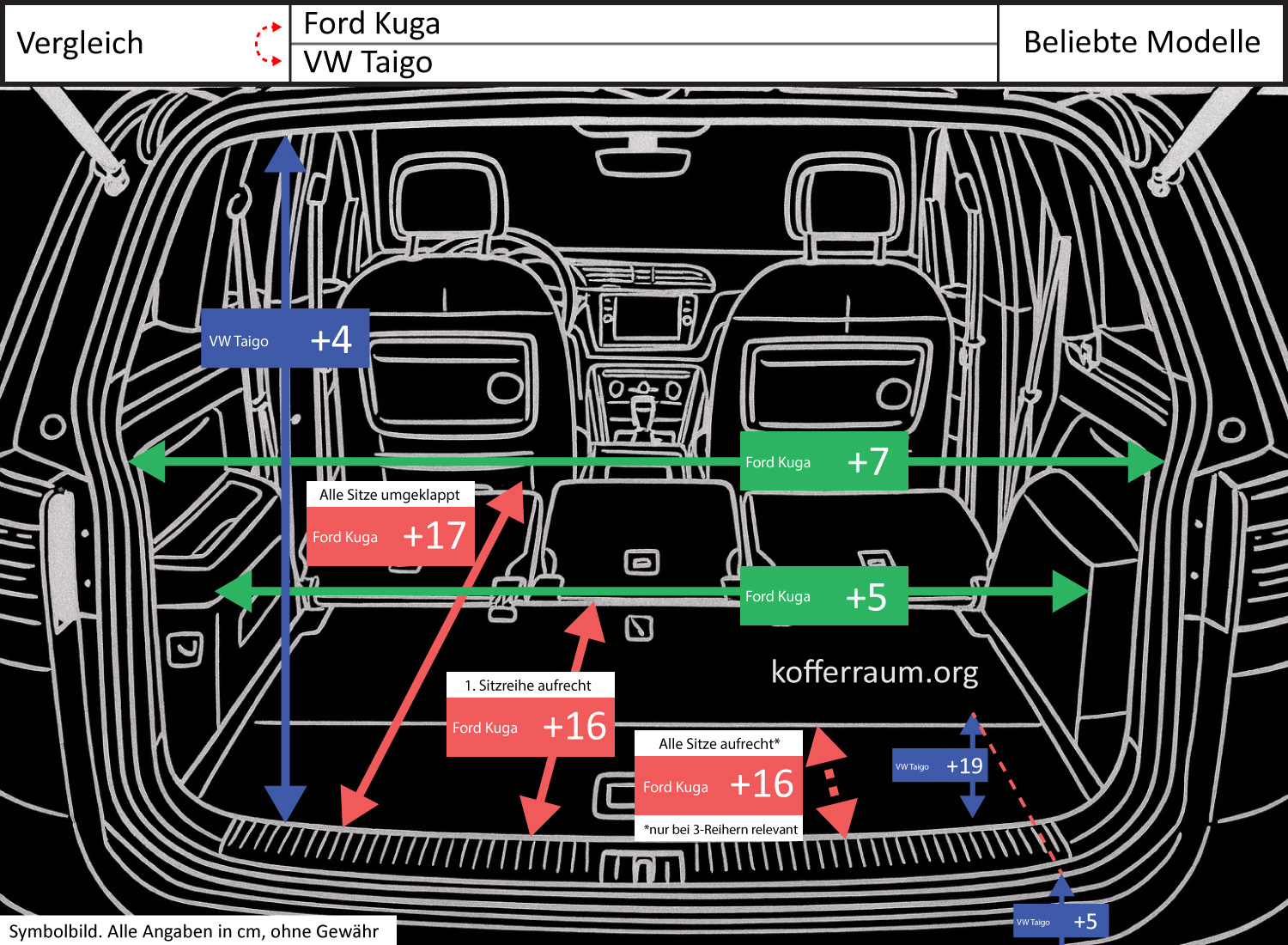
The Ford Kuga offers a cargo space that is +6.7 in (11%) longer with the seats folded down than the VW Taigo. With the front seats upright, the Kuga is also +6.3 in (20%) longer.
The most pronounced difference is in the depth between the loading edge and the trunk floor: the VW Taigo is +7.5 in (1900%) deeper here than the Ford Kuga.
Impact on Usability
More length in the Kuga (both with folded seats and upright seat row) improves handling of long items: furniture parts, slats, or longer luggage can be transported flatter and often without cross-loading.
When the seats are upright, the Kuga is more flexible for longer everyday items (skis, rolling suitcases, longer boxes).
The significantly greater depth of the Taigo means the trunk floor lies further below the loading edge — this provides more usable vertical volume and can better accommodate bulky or tall items without them protruding far into the passenger compartment.
Practically, this means volume-intensive or bulky cargo often fits "deeper" in the Taigo, resulting in less overhang.
At the same time, this deeper design can make loading and unloading heavy, flat items more difficult because they must be lifted further down or out.
Smaller differences (e.g., higher loading edge in the Taigo by +2 in/7%, higher opening by +1.6 in/5%, and somewhat narrower widths in the Taigo) also affect handling but are less significant than the three differences mentioned above.
In summary: The Kuga is more advantageous for transporting elongated items thanks to greater length, while the Taigo offers more vertical volume due to significantly greater depth, which is useful for transporting bulky cargo — at the cost of potentially more strenuous loading and unloading.