Trunk comparison: Ford Escape vs VW Tiguan
Key Difference
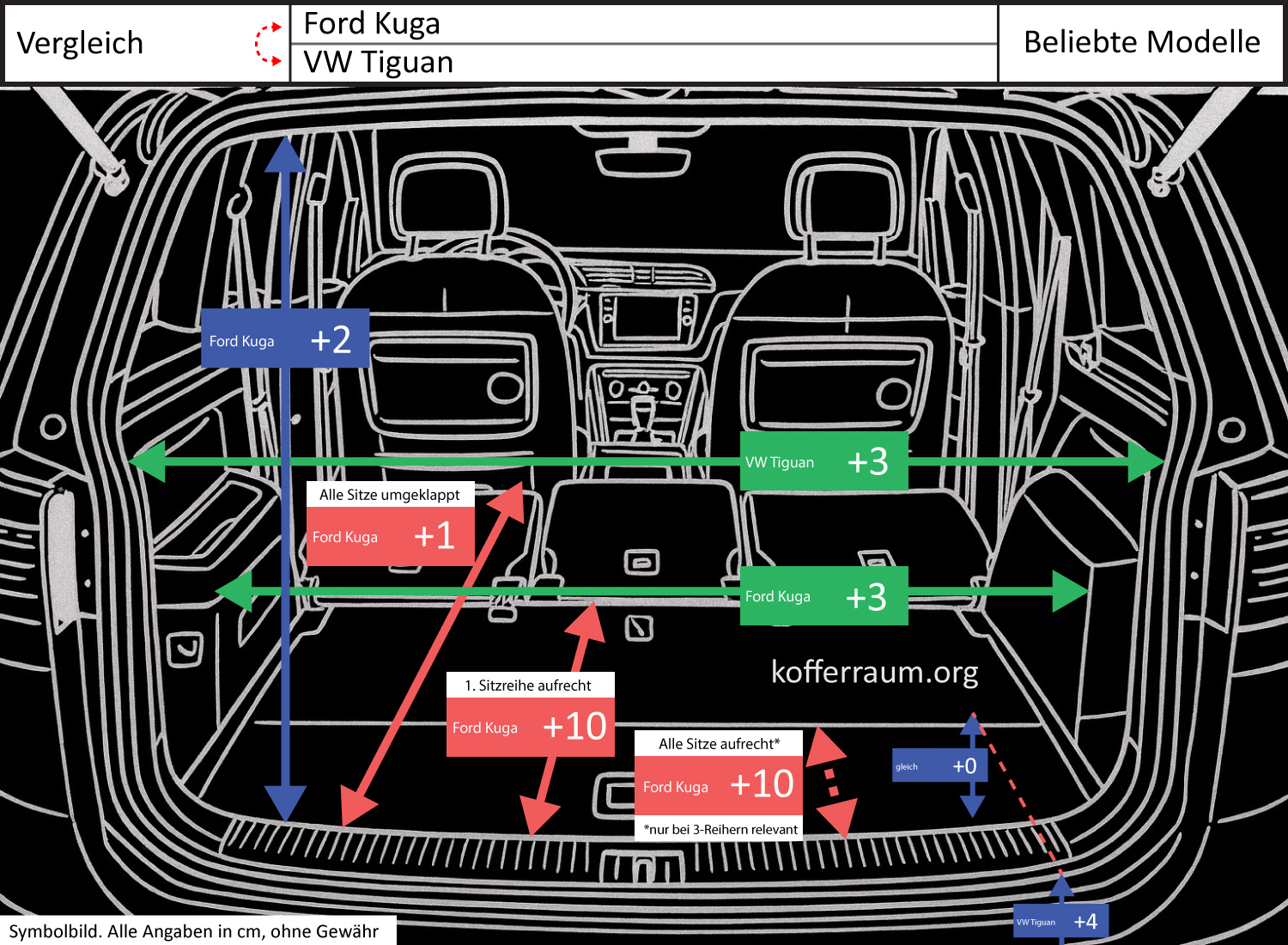
With the front seats upright, the Ford Kuga has a trunk that is 3.9 in (11%) longer than the VW Tiguan. This means: with full passenger occupancy, the Kuga offers significantly more usable cargo length for long items (e.g., skis, long boxes) or additional luggage without folding down the rear seats.
For users who often travel with passengers and cargo simultaneously, this is a noticeable advantage.
Other Differences (under 10%)
The remaining deviations are small:
- When all seats are folded down, the Kuga is only 0.4 in (1%) longer — practically negligible.
- The trunk opening of the Kuga is 0.8 in (3%) higher, while the Tiguan’s loading edge is 1.6 in (6%) higher above the ground.
- The narrowest interior width is 1.2 in (3%) larger in the Kuga, while the opening width is 1.2 in (3%) larger in the Tiguan.
- The depth of the trunk (loading edge to floor) is the same in both models.
Practical consequences of these smaller differences: the higher opening in the Kuga makes loading taller items somewhat easier; the lower loading edge of the Kuga makes lifting heavy loads a bit easier.
The Tiguan has a slightly wider opening, which can marginally ease inserting very wide items through the rear opening, but the somewhat narrower interior width can partly offset this.
Conclusion
Overall, both models are very similar; the decisive advantage lies with the Kuga: the significantly greater cargo length with seats upright (+11%) makes it more practical for everyday use with passengers and additional luggage.
The remaining differences are minor and only slightly noticeable in specific use scenarios (easier lifting and somewhat higher opening in the Kuga; minimally wider opening in the Tiguan).