
Trunk comparison: Hyundai i10 vs Mazda Mazda CX-5
Key Differences
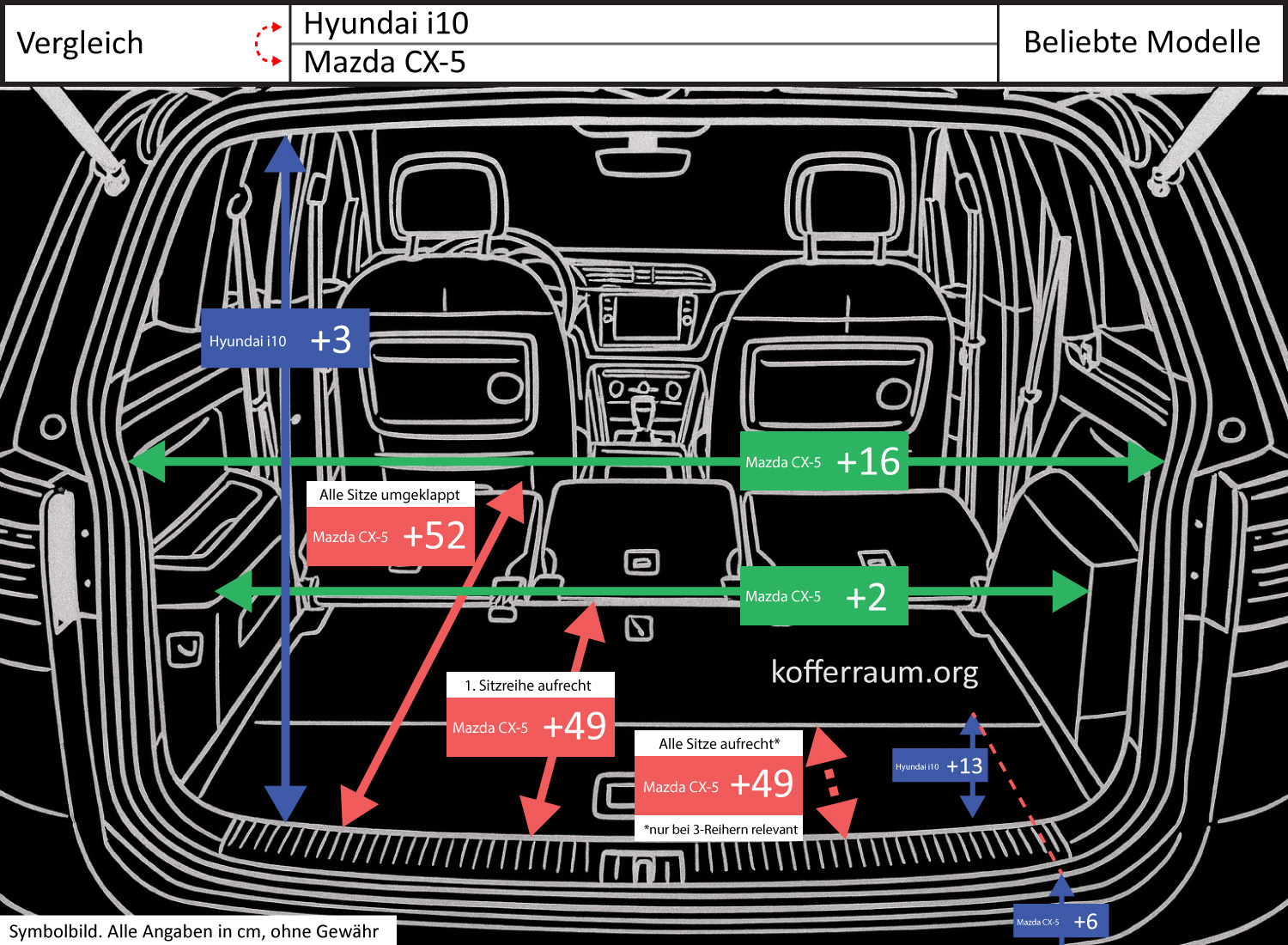
Four differences stand out from the data: The Mazda CX‑5 offers a significantly longer cargo area with the seats folded down (+20.5 in, +44%) and also a much greater trunk length with the first row of seats upright (+19.3 in, +104%).
The width of the CX‑5's trunk opening is noticeably larger (+6.3 in, +18%), which makes maneuvering wider items inside easier. The Hyundai i10, on the other hand, has a significantly greater depth between the loading edge and the trunk floor (+5.1 in, +260%), meaning a deeper cargo profile.
What this means for usability
For long or bulky loads (e.g., slats, long boxes, longer furniture parts, possibly bikes without the front wheel), the Mazda CX‑5 clearly has the advantage: the significantly greater length with folded seats plus the wider opening make loading, maneuvering, and securing easier.
Even with normal use and the rear seat upright, the CX‑5 offers substantially more storage space, allowing larger suitcases or groceries to be transported without folding the seats down.
The Hyundai i10 scores with its deeper cargo area. This is advantageous when storing smaller or loose items, as they can be placed lower and thus more securely.
For short, not very wide loads and daily city use (groceries, bags, smaller luggage), the i10 is practical because smaller items can "sink" better and shift less. The slightly higher loading edge and opening height of the CX‑5 and the minor width differences are less critical in everyday use.
In short: Those who regularly transport long or wide loads are better served by the Mazda CX‑5. Those who mainly need compact, stable storage for everyday use benefit from the deeper cargo space of the Hyundai i10.