
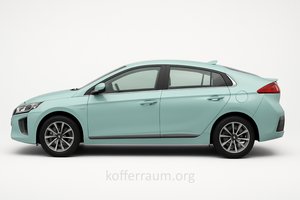
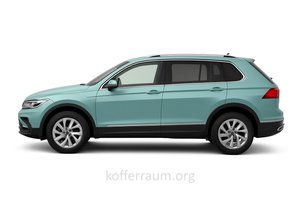
Trunk comparison: Hyundai IONIQ vs VW Tiguan Allspace
Key Differences (highlighted >10%)
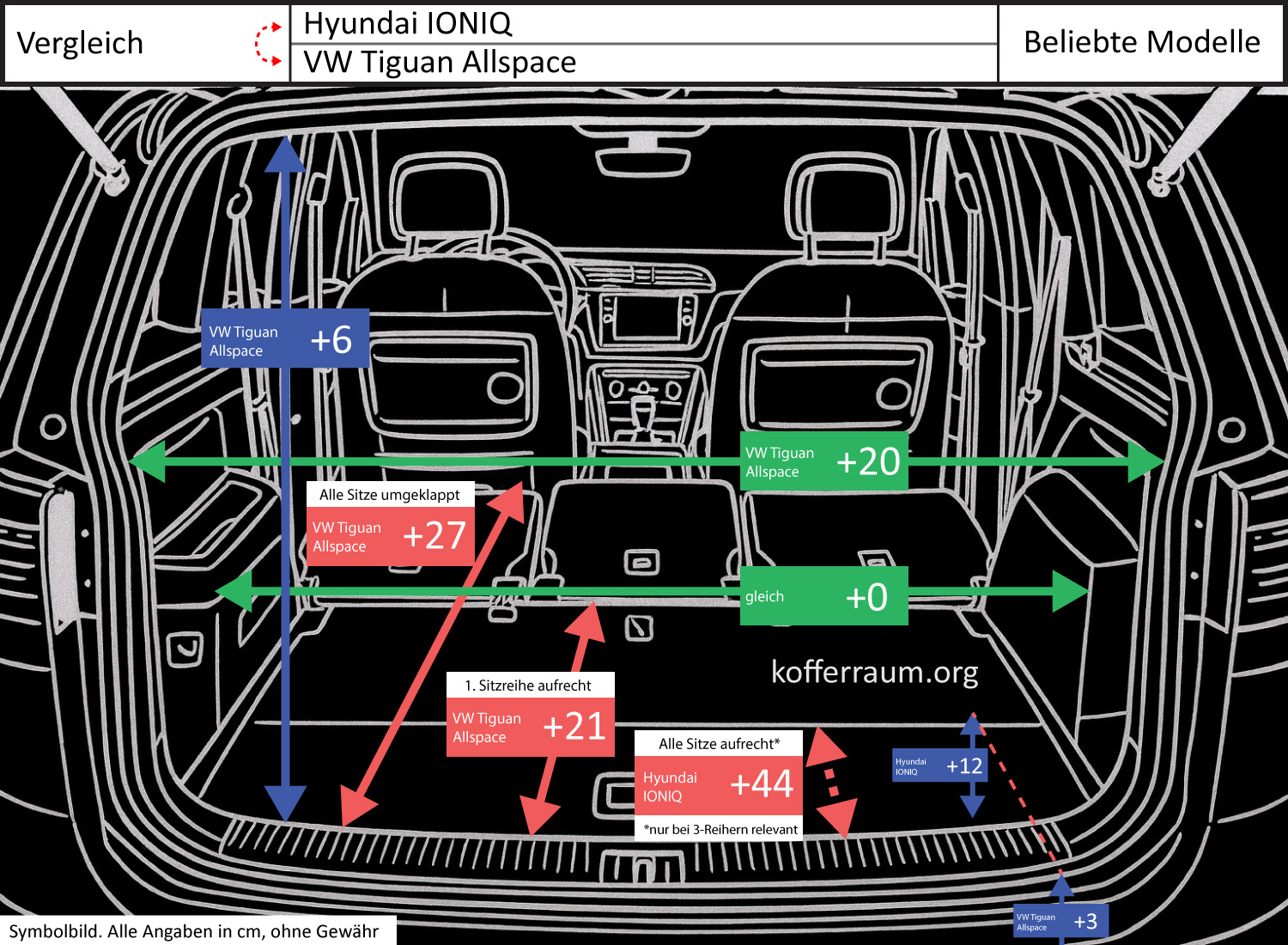
VW Tiguan Allspace offers +10.6 in (17%) more cargo length with seats folded down than the Hyundai IONIQ. Similarly, the Tiguan has +8.3 in (23%) more cargo length with the front row upright. This makes the Tiguan more flexible for long items when seats are folded or the front row is used.
Hyundai IONIQ has +17.3 in (94%) more trunk length with all seats upright than the Tiguan Allspace. This means significantly more usable trunk space in everyday use with full occupancy — better for suitcases or shopping with a full passenger load.
The cargo depth (loading edge to trunk floor) of the IONIQ is significantly larger: +4.7 in (1100%). Practical result: the IONIQ has more “recessed” storage space below the loading edge (more hidden/vertical usable capacity).
Combined with the slightly lower loading edge of the IONIQ (VW is only +1.2 in higher), loading is easier and more volume fits under the opening — however, very heavy items may be more awkward to handle due to the deeper recess.
The width of the trunk opening is +7.9 in (21%) larger on the VW Tiguan Allspace, while the narrowest interior width is the same on both models. Result: wide bulky parts can be loaded more easily crosswise in the Tiguan, but the tightest interior space remains the same.
Other, smaller differences
The height of the trunk opening is +2.4 in (9%) higher on the Tiguan — a small advantage when sliding in tall items, but under 10% and thus less pronounced. The Tiguan’s loading edge is +1.2 in (4%) higher above the road — marginally harder to load.
Practical recommendation
- More space with full occupancy (luggage for passengers): Hyundai IONIQ better.
- Frequent long or extra wide loads with folded seats: VW Tiguan Allspace better (longer cargo area, larger opening).
- For easier loading/unloading and more hidden storage under the loading edge: Hyundai IONIQ.