
Trunk comparison: Kia Sportage vs Peugeot 208
Key Differences
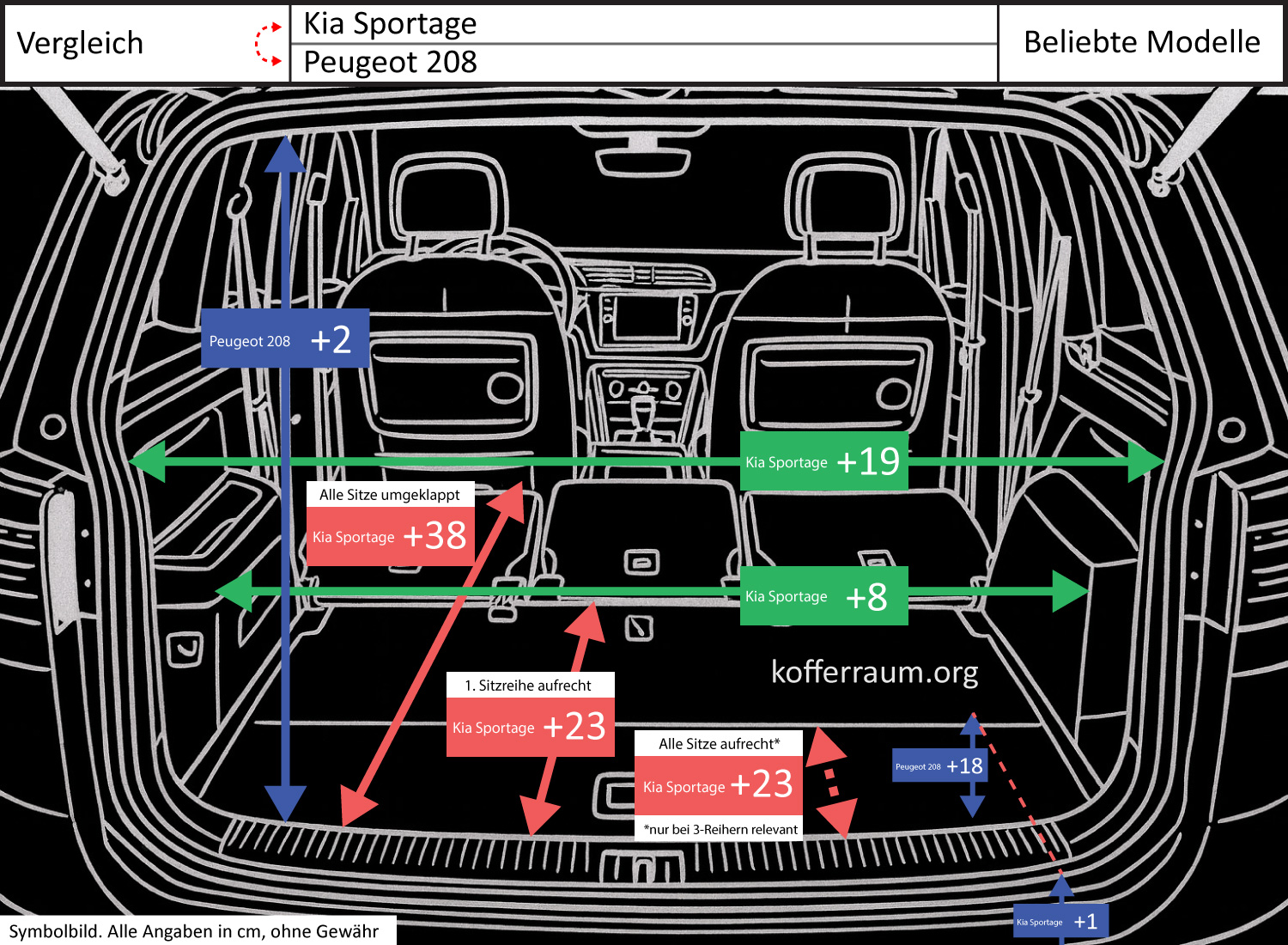
In the comparison, it is particularly noticeable that the Kia Sportage offers significantly more loading length: the trunk length with the seats folded down is 15 in (29%) longer and with the first row upright 9.1 in (34%) longer than in the Peugeot 208. Additionally, the width of the trunk opening in the Sportage is 7.5 in (22%) larger.
On the other hand, the Peugeot 208 has a significantly greater installation depth between the loading edge and the trunk floor — this is 7.1 in (1700%) higher than in the Sportage.
Smaller differences (e.g., opening height +0.8 in in the 208, loading edge height +0.4 in in the Sportage, width at the narrowest point +3.1 in in the Sportage) are under 10% and are not highlighted here.
Implications for Practical Usability
The larger length dimensions and the wider opening of the Kia Sportage make it more practical for long or bulky items: furniture, longer boxes, or pipes can be more easily loaded because more usable depth and a wider entry are available.
The larger opening width facilitates maneuvering bulky cargo through the tailgate.
The significantly greater depth distance (loading edge to trunk floor) in the Peugeot 208 means that the trunk is designed as a deeper storage space.
This is advantageous when you want to store items securely and deeper down (less shifting, better concealment of luggage), but it can make loading and unloading hard-to-reach or heavy items more difficult because they extend further downward.
Since the loading edge and opening height differ only slightly, no significant ergonomic differences are expected here.
In summary: For transport tasks involving long or wide loads, the Kia Sportage is clearly advantageous. For deeper stacked cargo or when a "deep" trunk profile is desired, the Peugeot 208 offers a different, more vertically oriented utility profile.