Trunk comparison: Kia Sportage vs VW T-Roc
Key Differences (Values >10% Highlighted)
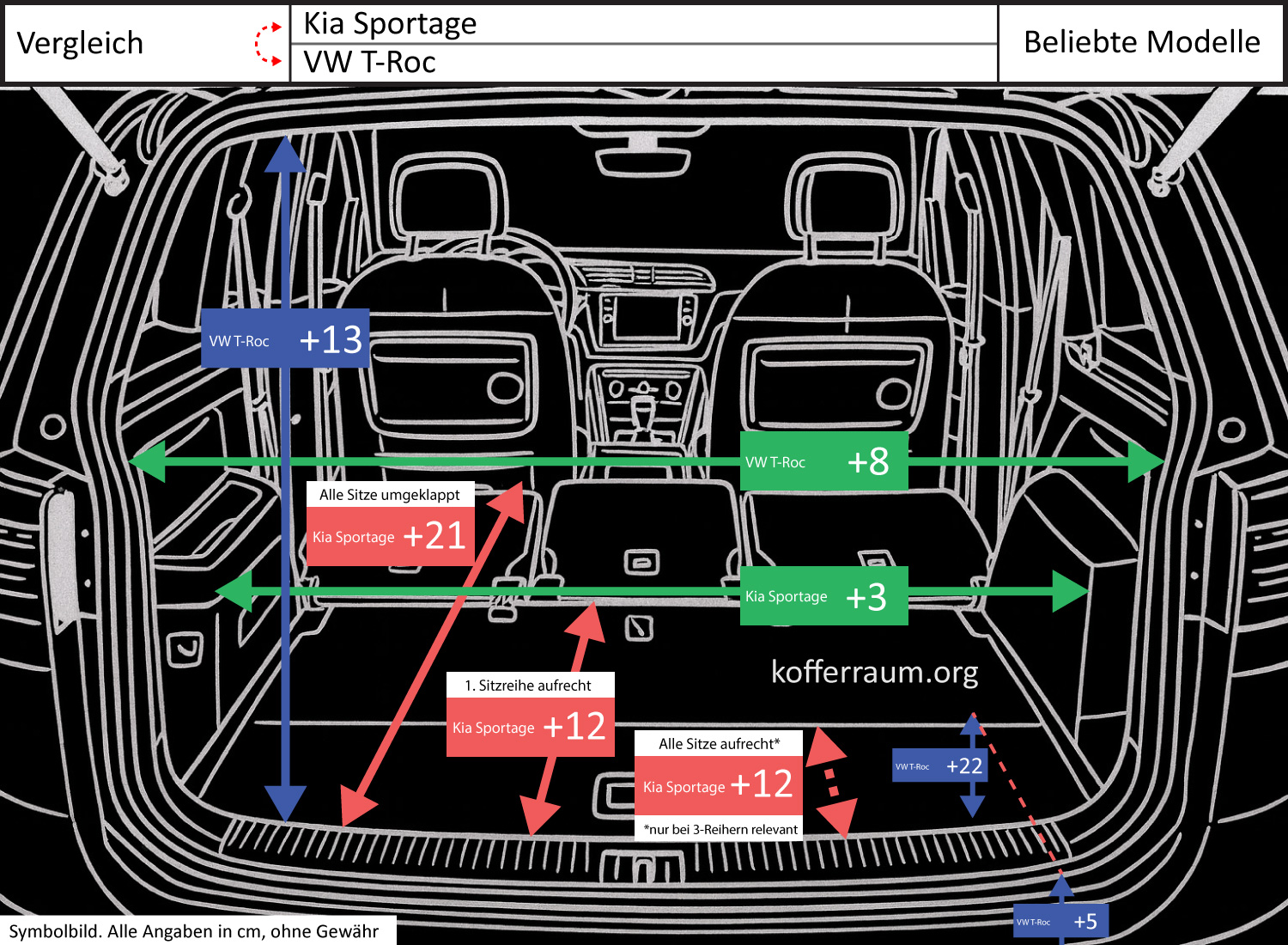
The Kia Sportage offers a 8.3 in (14%) longer cargo area with the seats folded down compared to the VW T-Roc. Even with the first row of seats upright, the Sportage is 4.7 in (15%) longer than the T-Roc.
In contrast, the VW T-Roc has a 5.1 in (18%) higher trunk opening and a significantly greater depth (loading edge to trunk floor): 8.7 in (2100%) higher than the Sportage.
Other, Smaller Differences
The loading edge of the T-Roc is 2 in (7%) higher above the ground than that of the Sportage. The narrowest width in the trunk is 1.2 in (3%) larger in the Sportage, while the width of the trunk opening is 3.1 in (8%) larger in the T-Roc — both below the 10% threshold.
Practical Implications
The longer loading length of the Sportage (with seats folded and upright) makes it better suited for long items such as slats, skis, furniture parts, or longer packages — they can be placed flatter and pushed further back. Those who regularly transport long or flat cargo will notice clear advantages with the Sportage.
The T-Roc scores with more vertical space: the higher opening and significantly greater depth create more height and a higher cargo volume vertically, making it easier to fit tall items or bulky boxes.
However, the loading edge in the T-Roc is slightly higher, which makes lifting heavy loads in somewhat more strenuous.
The much greater depth (loading edge to floor) also means that cargo sits lower in the vehicle — advantageous for volume but potentially less convenient when loading heavy items or retrieving very low-lying objects.
Conclusion: For long, flat cargo, the Kia Sportage is more practical; for taller or bulkier items and more vertical space, the VW T-Roc is better suited. Smaller differences in widths and loading edges are secondary for everyday usability.