
Trunk comparison: Mazda Mazda CX-5 vs Mercedes Benz GLC


Summary of the Biggest Differences
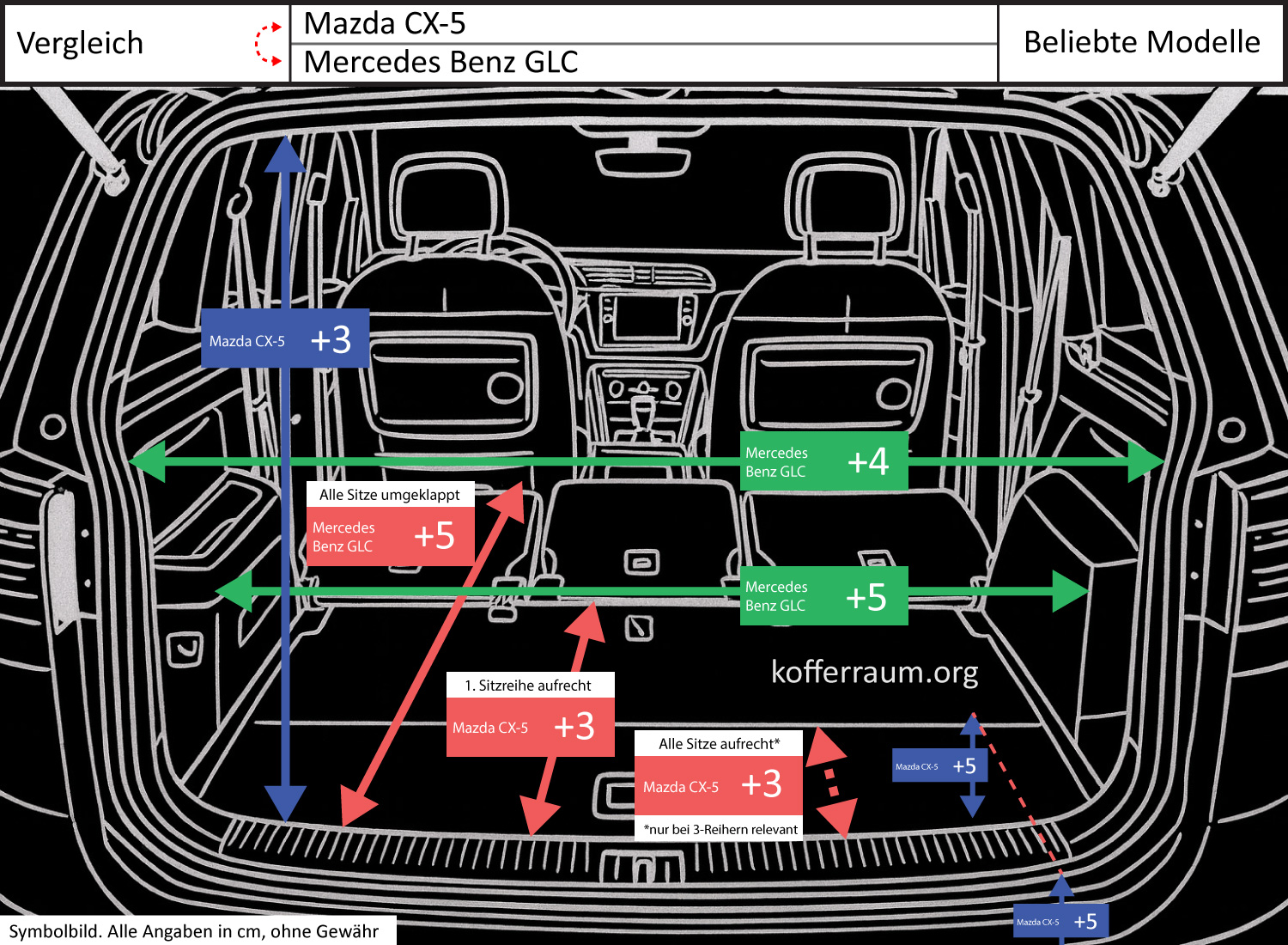
The data reveals several small gaps of 3–7% between the models, mainly in length, width, and trunk opening height. However, the trunk depth (loading edge to trunk floor) stands out significantly: the Mazda CX-5 is about 2 in higher here, which is indicated as +400% in the available data.
Other differences (not >10%) are: with the rear seat upright, the Mazda is 1.2 in longer; with seats folded down, the GLC is 2 in longer; the Mazda's trunk opening is 1.2 in higher; the Mazda's loading edge is 2 in higher above the ground; the narrowest width and opening width are 2 in and 1.6 in larger in the GLC, respectively.
What Are the Practical Implications of These Differences?
The much greater depth in the Mazda (noted as +400% in the data) practically means more space below the loading edge: the vehicle offers a deeper cargo compartment there, which helps when transporting small, stackable, or durable items and reduces cargo shifting.
This difference is significant for users who frequently transport bulky or irregularly shaped loads because it creates more usable interior space.
The higher loading edge of the Mazda (+2 in) makes lifting heavy items somewhat more strenuous; for frequent loading of heavy cargo, the lower GLC entry is more comfortable. The slightly higher trunk opening of the Mazda (+1.2 in) slightly eases inserting tall items.
The greater width of the GLC (narrowest point +2 in, opening width +1.6 in) is advantageous when wide items (e.g., furniture parts, larger boxes) need to be loaded — bulky cargo is more likely to fit through the opening and into the cargo space.
The length differences are small: with the first row upright, the Mazda offers slightly more depth (+1.2 in); with seats folded down, the GLC has somewhat more length (+2 in). These differences are hardly noticeable in many everyday situations but can be decisive for very long items (e.g., slats, panels).
Conclusion: For users who benefit from a deeper load floor and more internal volume (stackable or irregular cargo), the Mazda is more favorable.
Those who require easier loading (lower loading edge) or better width and pass-through capability for wide items benefit more from the GLC. The remaining differences are small and have only minor practical effects.