
Trunk comparison: Mazda Mazda CX-5 vs Opel Astra Wagon

Key Differences
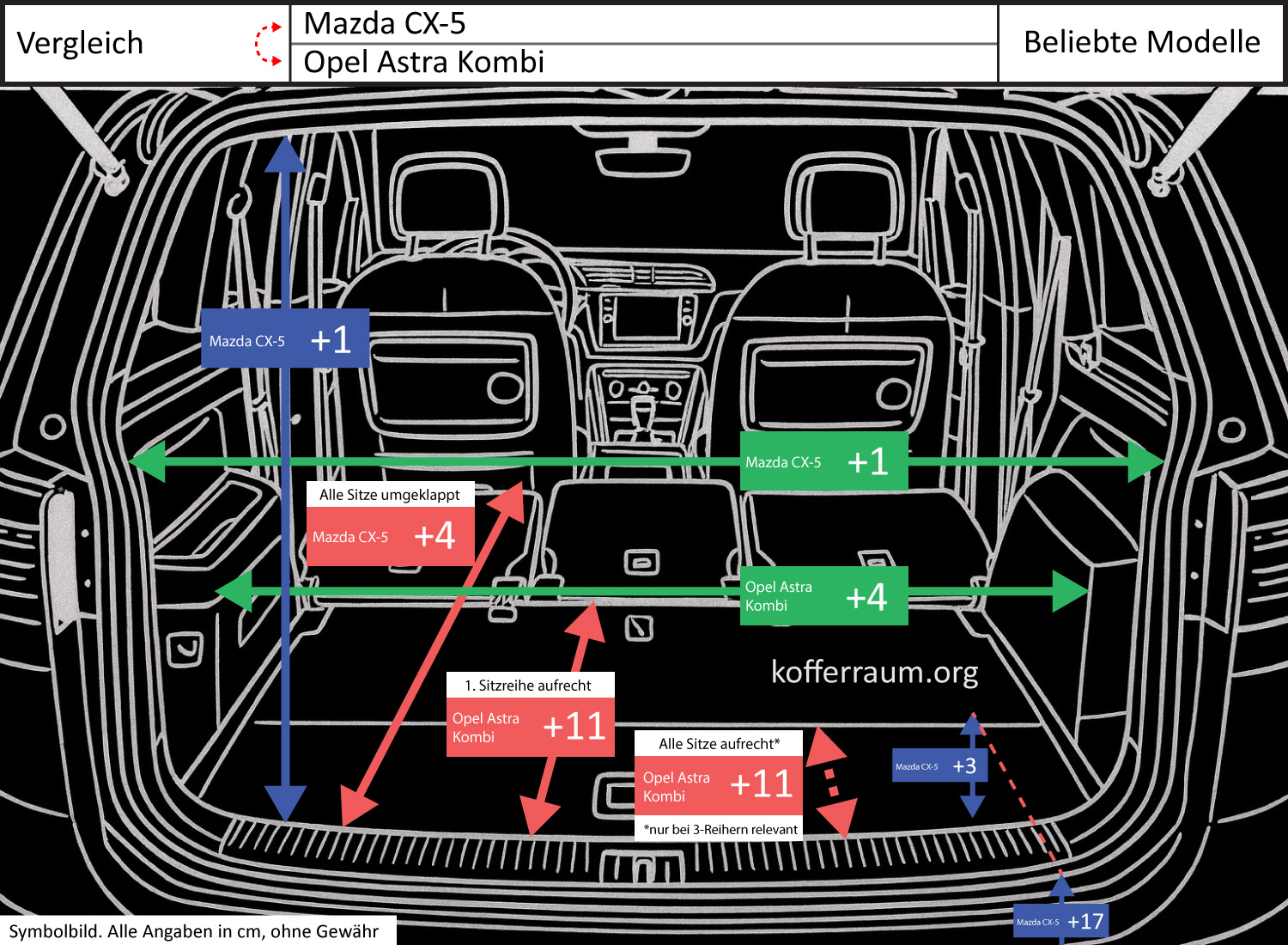
Opel Astra Wagon: longer trunk with front seats upright — with the front seat row upright, the Astra's trunk is 11% (+4.3 in) longer than the Mazda CX‑5's. This difference exceeds the 10% threshold and is therefore significant.
Mazda CX‑5: significantly deeper trunk well — the depth of the trunk (loading edge to trunk floor) is 150% (+1.2 in) greater in the Mazda. This is a clear, practically relevant difference.
Mazda CX‑5: higher loading edge — the Mazda's loading edge is 29% (+6.7 in) higher above the road than the Astra's. This difference also exceeds 10% and affects handling.
Other figures (trunk length with seats folded +2% in favor of Mazda; width at narrowest point +4% in favor of Astra; width and height of opening ±1%) are under 10% and thus secondary.
Impact on Usability
The longer trunk of the Astra with the seat row upright makes it more practical for long items that need to be transported without folding the seats (e.g., boards, skis, long boxes). Those who frequently carry such long loads directly benefit from the Astra.
The greater depth of the trunk well in the Mazda increases usable volume behind the loading edge and ensures that luggage or groceries sit deeper and are less likely to roll out.
However, combined with the higher loading edge, this creates a disadvantage: lifting heavy or bulky items requires more effort because they must be raised over a significantly higher edge. For frequent loading and unloading or heavy loads, the Astra's lower loading floor is more ergonomic.
The smaller differences in width and opening dimensions are hardly noticeable in practice; they only slightly affect everyday usability.
In summary: Astra scores with length and easier loading, Mazda offers a deeper loading area with somewhat better securing of lower-lying cargo but pays for it with a significantly higher loading edge.