
Trunk comparison: Mazda Mazda CX-5 vs Opel Grandland


Key Statement
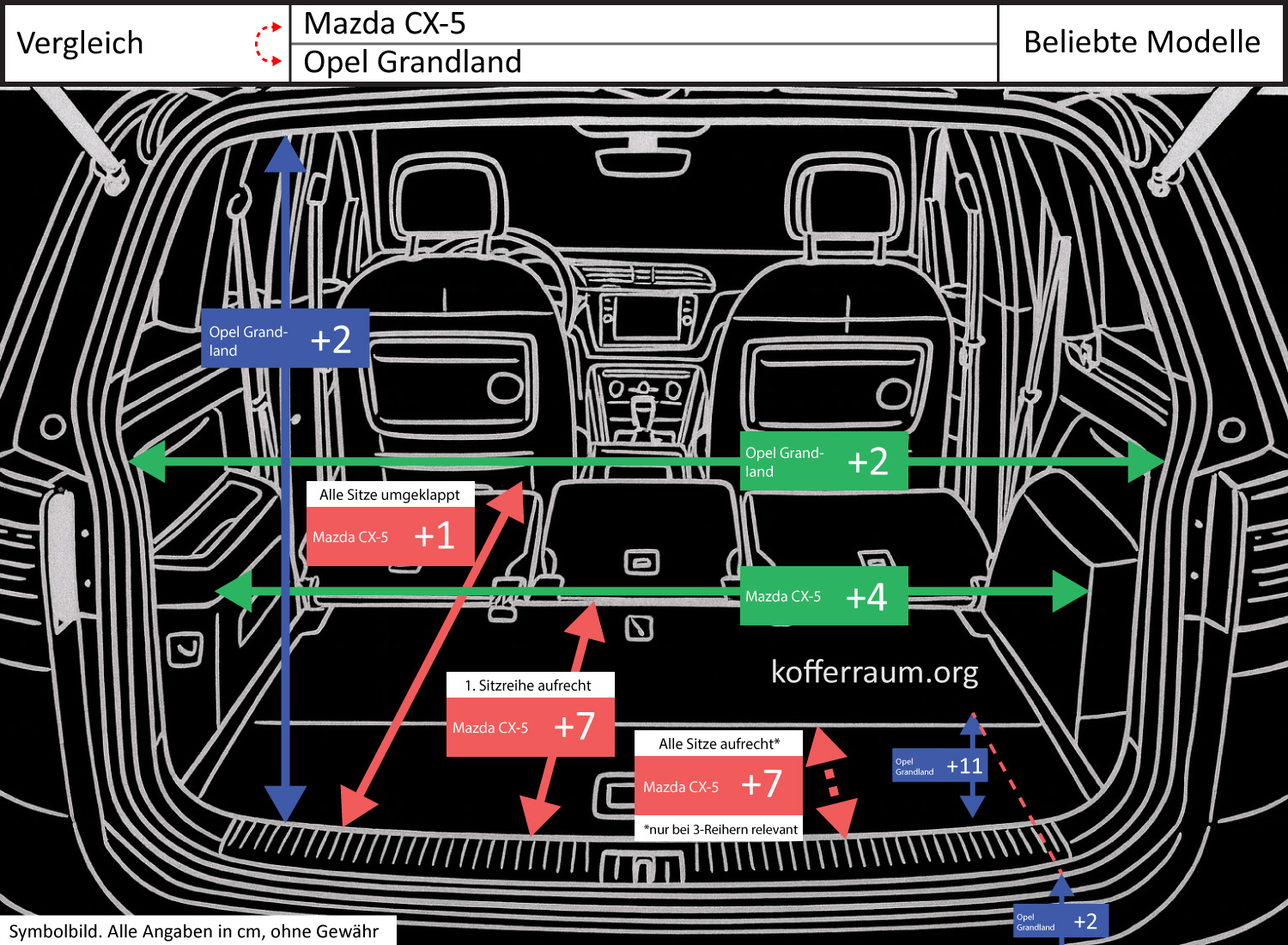
The most noticeable and only difference over 10% concerns the depth of the trunk: The Opel Grandland has a trunk depth from the loading edge to the trunk floor that is 4.3 in (220%) greater than the Mazda CX‑5.
What this means in practice
The greater trunk depth of the Grandland allows bulky or flat items to be pushed further back and stacked higher without protruding into the loading edge area. This increases the usable cargo volume especially for bulky, flat loads or when storing many inserted parts.
Disadvantages may arise when loading and unloading heavy items, as they have to be moved further into the trunk; however, this is not significantly worsened by the only slightly higher loading edge (+0.8 in).
Other, smaller differences (under 10%) and their consequences
- Mazda CX‑5: at the narrowest point of the trunk +1.6 in (≈4%) wider — easier transport of very wide items and better use of interior space with asymmetrical loading.
- Mazda CX‑5: with the first row of seats upright +2.8 in (≈8%) longer trunk; with seats folded down only +0.4 in (1%) — easier transport of longer items with passengers in the front seats, but no decisive advantage with fully folded seats.
- Opel Grandland: trunk opening +0.8 in (≈2%) wider and +0.8 in (≈3%) higher — minimally better access for wide or taller cargo items through the opening; also, the loading edge is overall +0.8 in higher above the road surface, which slightly affects lifting in.
Conclusion
For users who frequently store deep, bulky cargo or need a lot of stacking capacity near the loading edge, the Opel Grandland is advantageous due to the significantly larger trunk depth.
Those who transport rather wide items or rely on the narrowest passage width benefit slightly from the Mazda CX‑5. The remaining differences are comparatively small and rarely decisive in everyday use.