
Trunk comparison: Mazda Mazda CX-5 vs Peugeot 208
Key Differences (Highlighted)
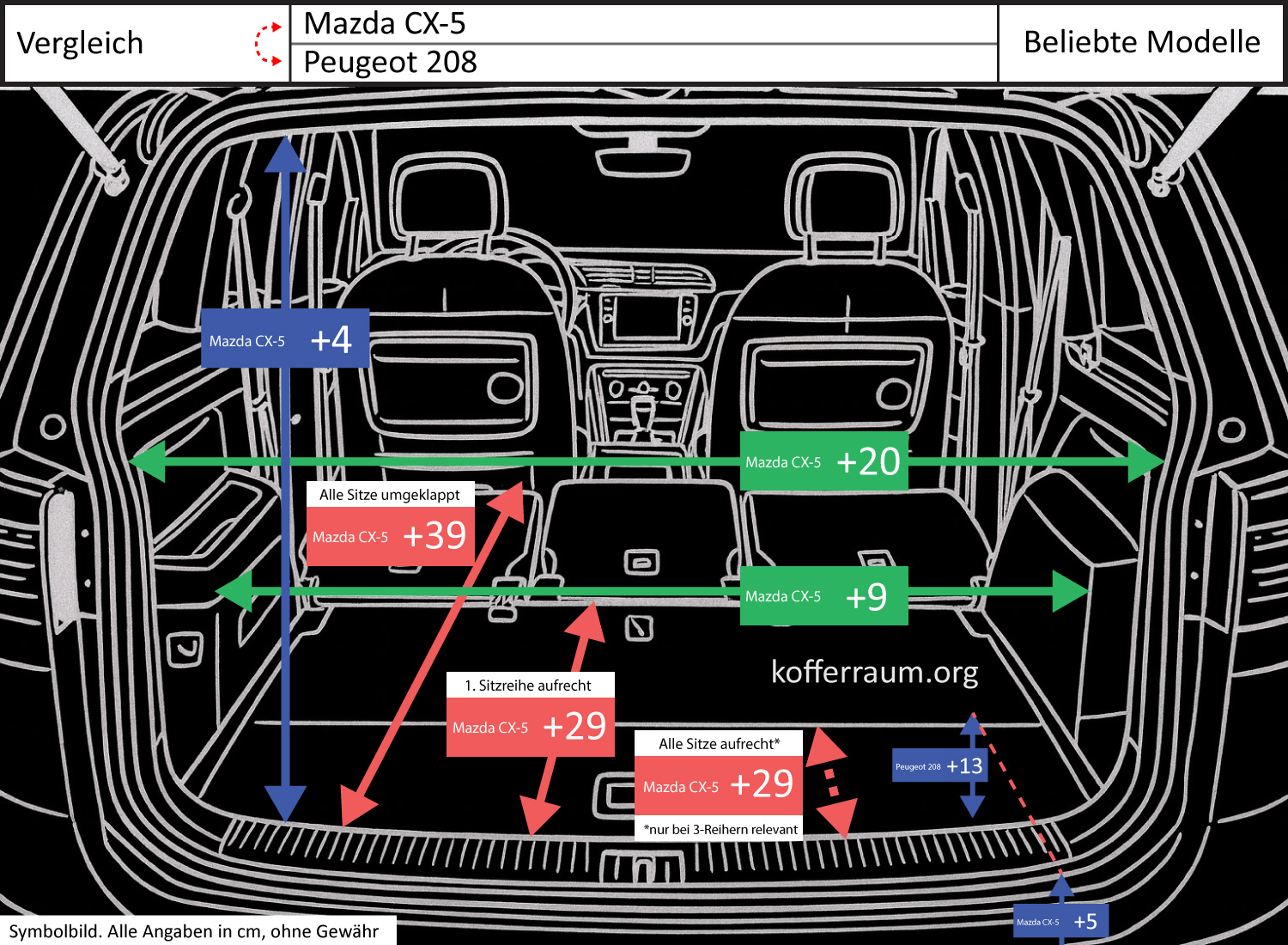
The Mazda CX‑5 offers a significantly longer cargo area: with the seats folded down, it is 15.4 in (≈30%) longer, and with the first row of seats upright, 11.4 in (≈43%) longer than the Peugeot 208. Additionally, the width of the trunk opening on the Mazda is 7.9 in (≈23%) larger, which makes loading wider items easier.
In contrast, the Peugeot 208 has a significantly greater "depth" between the loading edge and the trunk floor: it is 5.1 in (≈260%) deeper here than the Mazda.
Impact on Usability
Mazda CX‑5 — Advantages in everyday use and transport: The longer cargo area (especially with folded seats) and the wider opening make the CX‑5 better suited for long or bulky items (e.g., furniture, sports equipment, skis, larger suitcases).
The larger opening width reduces maneuvering when loading bulky parts. Disadvantages include a slightly higher loading edge (2 in), which means very heavy items need to be lifted a bit more.
Peugeot 208 — Advantages and limitations: The significantly greater depth (loading edge→trunk floor) means that cargo sits deeper in the vehicle and can lie more stably; smaller items are less likely to shift.
However, for very heavy or bulky, long items, the 208 is unsuitable due to the considerably shorter cargo length and narrower opening. Thanks to the low loading edge of the 208, lifting is easier than with the Mazda.
Conclusion: For transport tasks involving long or wide items and greater versatility, the Mazda CX‑5 is clearly advantageous. The Peugeot 208 can score points for city-related use and for deeper, more stable luggage loading but is significantly limited in cargo length and width.