
Trunk comparison: Mazda Mazda CX-5 vs Renault Clio


Summary of the Key Differences
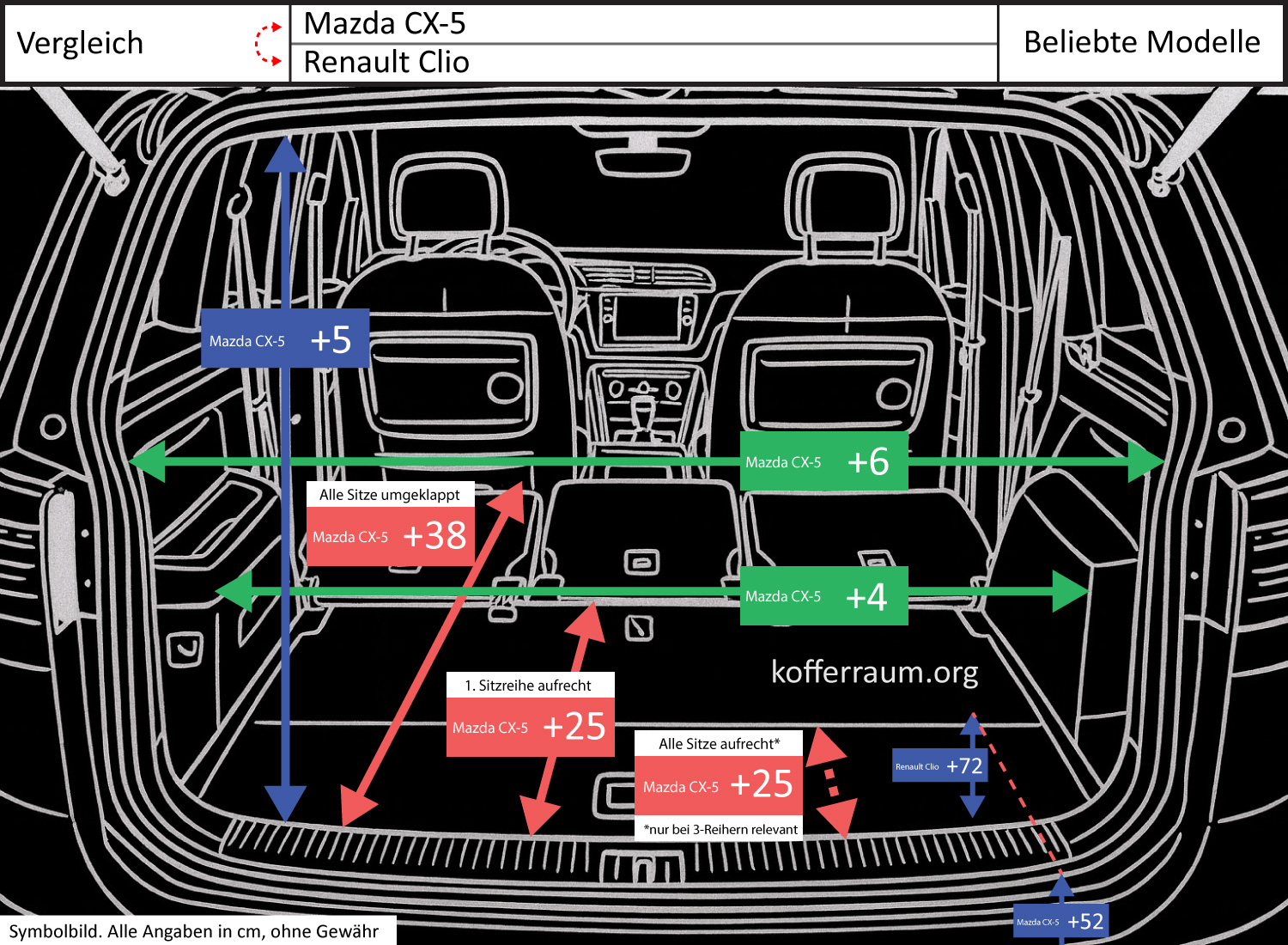
There are clear differences in capacity and loading geometry: The Mazda CX-5 offers a trunk that is 15 in (29%) longer with the seats folded down and a cargo space that is 9.8 in (35%) longer with the first row of seats upright compared to the Renault Clio.
The loading edge of the Mazda is significantly higher: 20.5 in (217%) above the road.
Conversely, the Renault Clio has a significantly greater depth between the loading edge and the trunk floor: 28.3 in (1440%) more than the Mazda. Smaller differences such as trunk opening height (+2 in / 7% in favor of the CX-5) and width differences (+4–2.4 in, 4–6%) are less decisive in everyday use.
Impact on Usability
These measurements have direct consequences for practical use: The greater length in the CX-5 makes it easier to transport longer or bulky items (e.g., furniture parts, skis, long boxes) with less shifting.
The higher loading edge of the CX-5, however, makes lifting heavy items into the trunk more difficult and increases the effort required when loading.
The Clio benefits from the large depth between the loading edge and the trunk floor: This creates more "room downward," which is useful when volume in depth or increased stacking height is needed (e.g., crates or shopping bags placed deep inside).
At the same time, the lower loading edge of the Clio is advantageous for loading and unloading heavy items or for frequent opening in daily use (shopping, stroller).
Conclusion: For transport lengths and bulky cargo, the Mazda CX-5 is clearly superior. For easy lifting, frequent daily loading, and use of the deep cargo floor, the Renault Clio is more practical.
Smaller width and opening height advantages of the CX-5 are secondary and do not significantly change the basic usability.