
Trunk comparison: Mazda Mazda CX-5 vs Tesla Model 3
Key Differences
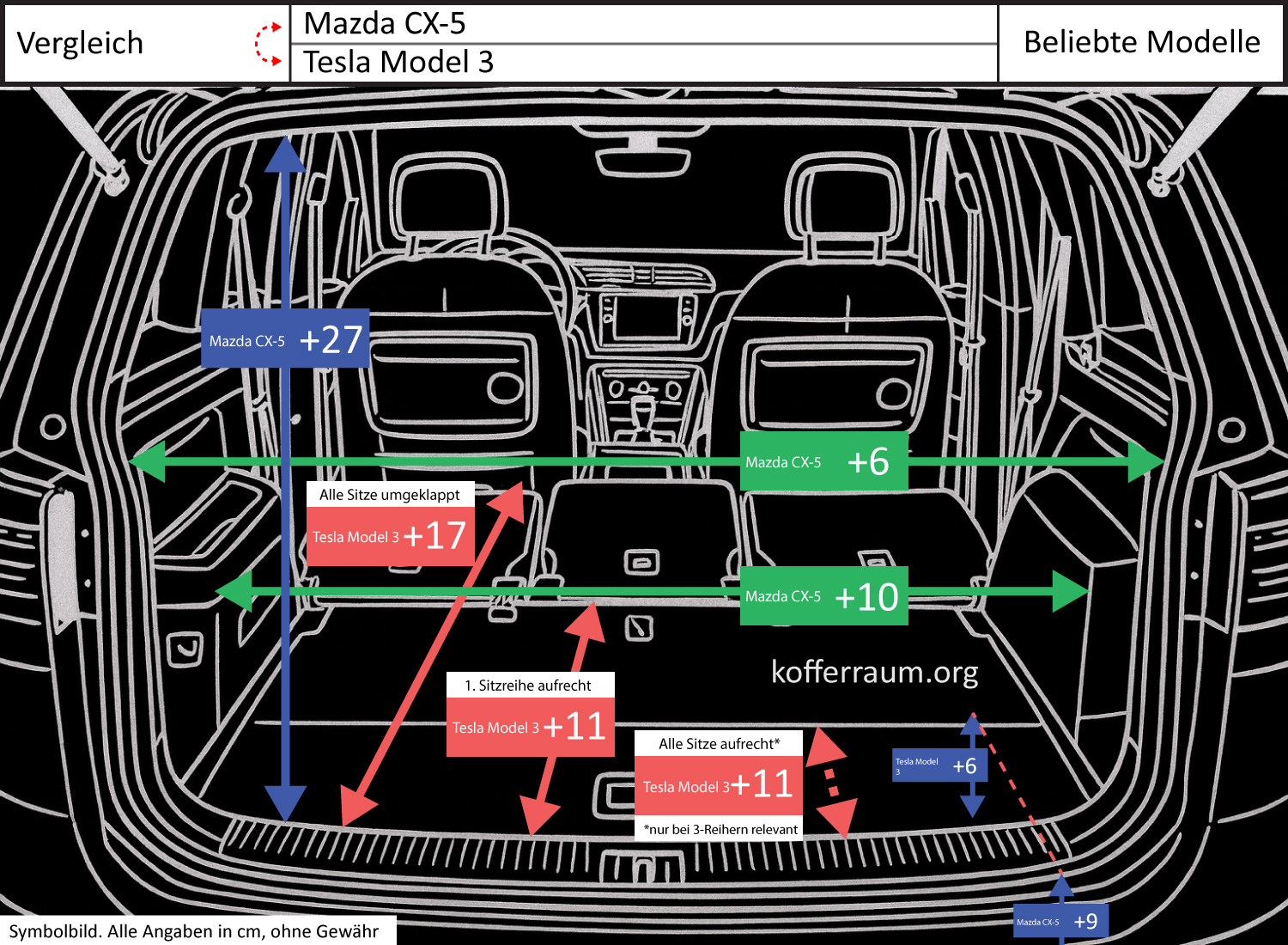
The most noticeable differences can be found in loading height, cargo depths, and usable width. The Tesla Model 3 offers a longer cargo space in the upright seat mode (+4.3 in / 11%), and the Model 3 also has a significantly larger cargo depth difference between the loading edge and the trunk floor (+2.4 in / 120%), resulting in a deeper cargo area.
On the other hand, the trunk opening of the Mazda CX-5 is significantly higher than that of the Tesla (+10.6 in / 52%). The Mazda’s loading edge is also noticeably higher above the ground (+3.5 in / 13%), and the Mazda has a greater cargo width at the narrowest point (+3.9 in / 11%).
Smaller differences not highlighted: the Model 3 has +6.7 in (10%) more length with folded seats, and the width of the Mazda’s trunk opening is only slightly larger (+2.4 in / 6%).
Impact on Usability
The Tesla Model 3 is better suited for long, flat, or heavy items: the longer cargo width with upright seats and the greater cargo depth combined with a lower loading edge make sliding in and lifting heavy loads easier. A deeper cargo profile also helps prevent luggage from shifting easily.
The Mazda CX-5 is more advantageous for tall or wide loads: the significantly higher trunk opening provides more vertical clearance for bulky or tall items, and the greater width at the narrowest point allows for wider cargo.
However, the higher loading edge makes handling heavy loads more difficult because they must be lifted higher.
Conclusion: For frequent transport of long and heavy items, the Tesla Model 3 is more practical; for tall or wide luggage and general flexibility with bulky objects, the Mazda CX-5 offers clear advantages.