
Trunk comparison: Mazda Mazda CX-5 vs Tesla Model Y
Key Differences (>10%)
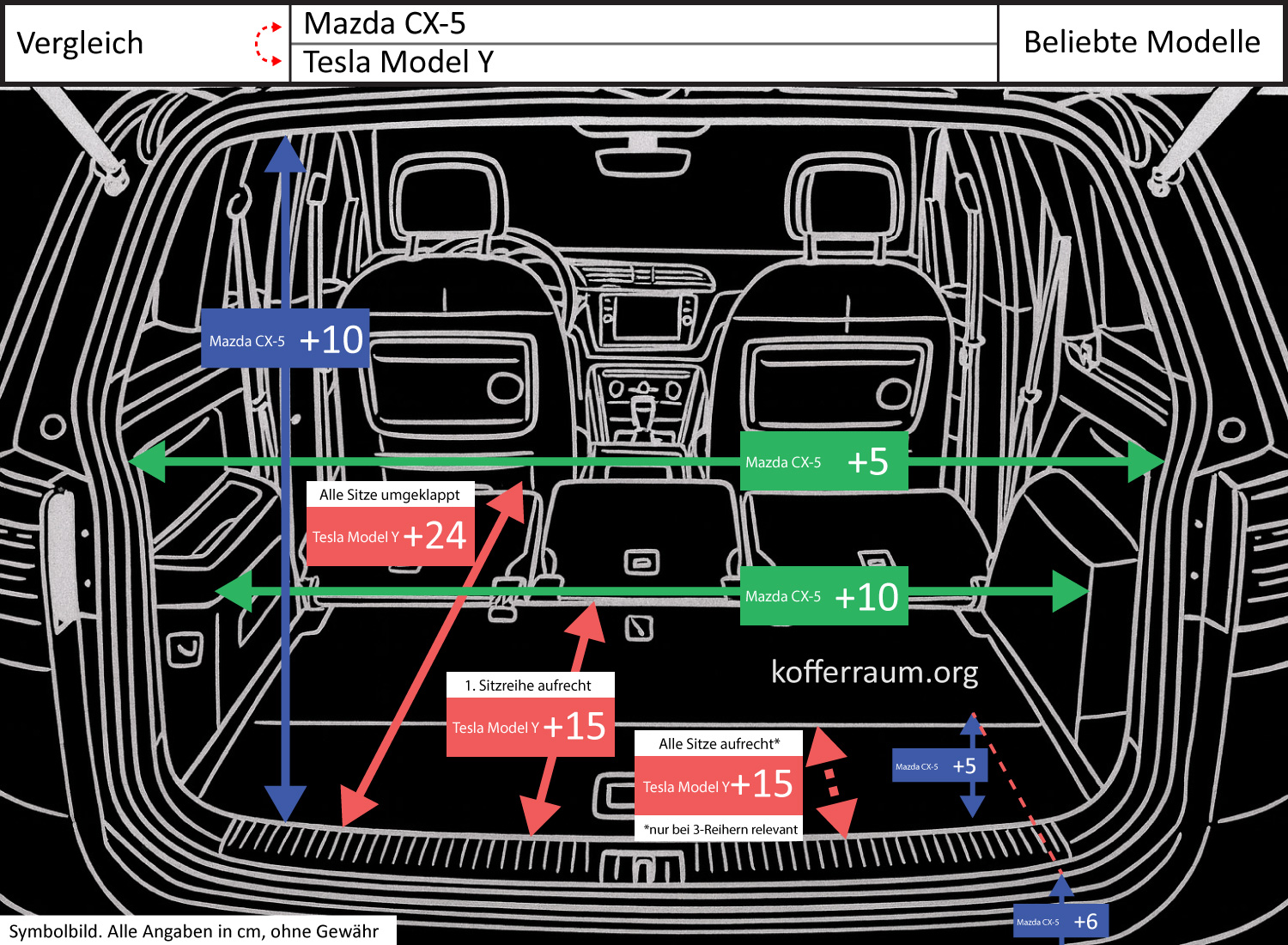
The Tesla Model Y offers a trunk that is 9.4 in (14%) longer with the seats folded down and a trunk that is 5.9 in (16%) longer with the first row of seats upright compared to the Mazda CX‑5. The Mazda, on the other hand, has a trunk opening that is 3.9 in (14%) higher, a depth (loading edge → trunk floor) that is 2 in (400%) greater, and a width at the narrowest point that is 3.9 in (11%) larger than the Model Y.
Impact on Usability
Cargo volume in length: Due to the greater length of the Tesla, the Model Y is particularly suitable for long items (e.g., slats, skis, long furniture parts)—especially when the seats are folded down. Those who frequently transport long loads tend to have fewer restrictions in the Model Y.
Space for wide or tall cargo: The Mazda is advantageous for bulky, voluminous, or wider cargo. The greater depth and wider narrowest point as well as the higher opening mean that bulky boxes, large suitcases, or irregularly shaped items fit more easily and can be stored more stably.
Loading comfort and handling: Although not over 10% difference, the loading edge of the Mazda is 2.4 in higher than that of the Tesla—this makes heavy lifting somewhat more strenuous when loading the Mazda, while the lower loading height of the Model Y facilitates loading and unloading heavy items.
The slightly greater width of the trunk opening on the Mazda (+2 in, 5%) has only limited practical impact.
Conclusion: For regular transport of long items, the Tesla Model Y is better suited. For frequent loading of bulky, wide, or tall items, the Mazda CX‑5 offers the more practical solution due to its larger opening, depth, and usable width.
The choice depends on the typical cargo profile (long vs. wide/voluminous) and the weight of the cargo (loading height).