
Trunk comparison: Mazda Mazda CX-5 vs Volvo V90
Main Differences (from the comparison text)
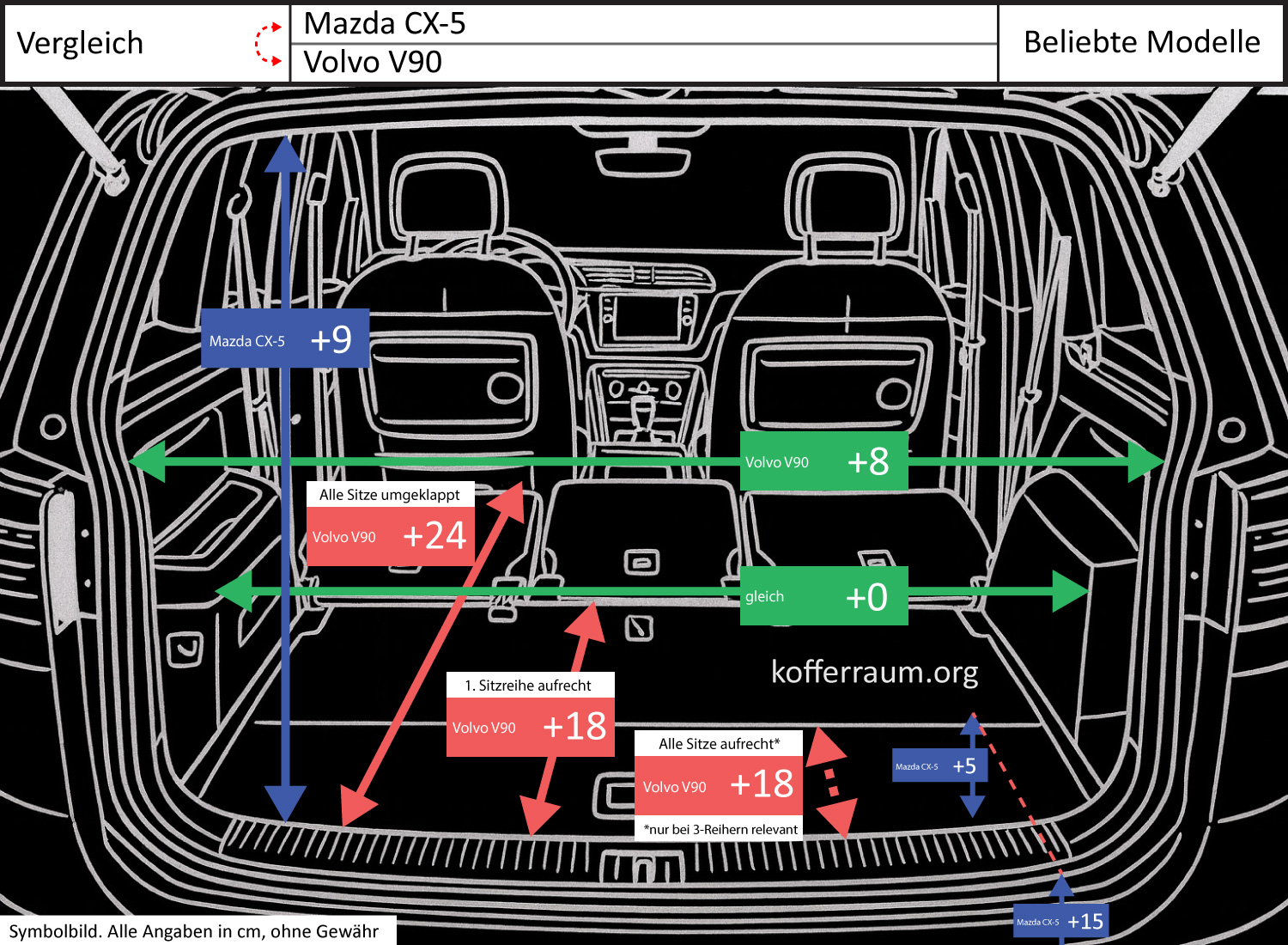
The Volvo V90 offers significantly more usable trunk length: with the seats folded down it is +9.4 in (≈14%) longer, and with the first row upright it is +7.1 in (≈19%) longer than the Mazda CX-5. In terms of cargo opening height, the Mazda has an advantage: the height of the CX‑5's trunk opening is +3.5 in (≈13%) higher than the V90. Likewise, the trunk depth (loading edge to trunk floor) of the CX‑5 is significantly greater than that of the V90: +2 in (≈400%).
The loading edge of the CX‑5 is also +5.9 in (≈25%) higher above the road than the V90. The narrowest width in the cargo area is the same for both models; the width of the trunk opening is only slightly larger on the V90 (+3.1 in / 8%), thus below the 10% threshold.
What impact do these differences have on practical usability?
The longer loading dimensions of the V90 make it noticeably better suited for long items (e.g., slats, skis, long furniture parts)—this applies both with folded seats and with the rear bench upright.
If you frequently need to transport long cargo, the V90 is more comfortable in practice because less folding or sideways protrusion is necessary.
The CX‑5 offers advantageous vertical dimensions: the higher trunk opening and the significantly greater depth (loading edge to ground) mean that taller or bulkier items can be better accommodated without protruding over the loading edge.
The deeper load floor profile can also help to store cargo somewhat lower and thus more stably and protected from wind.
However, the loading edge of the CX‑5 is significantly higher above the road—this makes handling heavy or bulky items more difficult because more lifting is required. The V90 with its lower loading edge is more practical here: heavy items can be slid in more easily or rolled into the trunk.
Since the narrowest loading width is the same in both vehicles, there is no difference for particularly narrow cargo. The slightly larger opening width of the V90 (+3.1 in / 8%) exists but is below the 10% mark and only noticeably affects edge cases.
In summary: For long, flat cargo the clear advantage is the V90. For taller, bulkier cargo (with lower height relative to the exterior dimension) and deeper-stored freight, the advantage is rather the CX‑5, but when lifting heavy loads the V90 is more practical due to the lower loading edge.