
Trunk comparison: Mazda Mazda CX-5 vs Volvo XC40


Key Differences
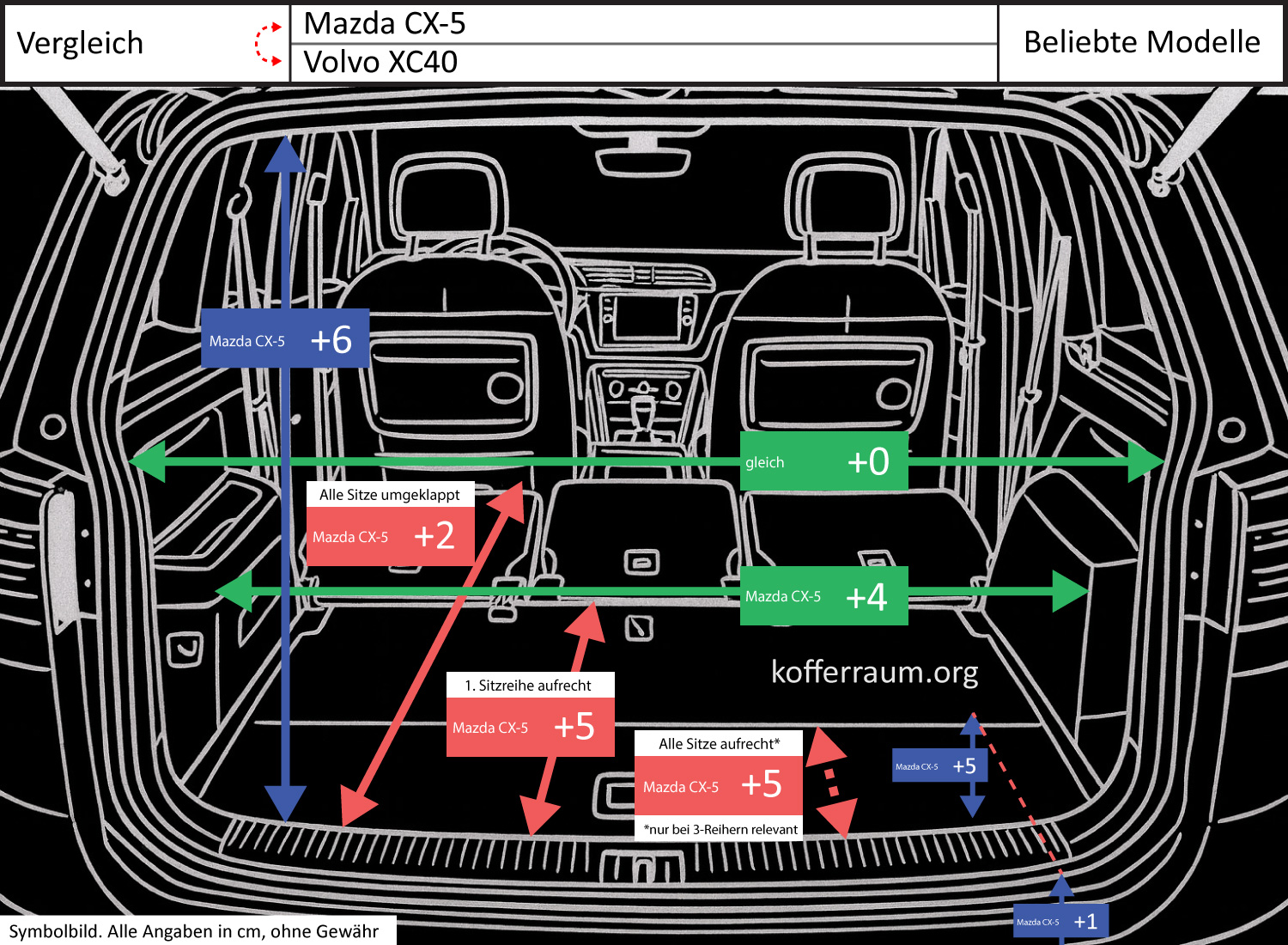
The measured values show only minor deviations between the models: With the seats folded down, the Mazda CX-5 is about 0.8 in (1%) longer, and with the first row of seats upright, about 2 in (5%) longer.
The opening height of the Mazda is 2.4 in (8%) greater, the loading edge is 0.4 in (1%) higher, and the narrowest width in the trunk is 1.6 in (4%) larger in the Mazda. The width of the trunk opening is the same for both models.
Notably, the depth between the loading edge and the trunk floor is where the Mazda CX-5 exceeds the Volvo XC40 by 2 in (400%).
Impact on Usability
The much greater depth (distance loading edge ↔ trunk floor) in the Mazda results in a distinctly different loading feel: it creates a more pronounced "trunk shell" with a noticeable height offset to the loading edge.
Practical consequences are that smaller or loose items stay better in the trunk and are less likely to roll out — the cargo sits deeper and thus more securely.
On the other hand, loading and unloading heavier or bulkier items becomes somewhat more cumbersome because lifting them in requires overcoming the offset, and sliding large, flat items through may be more difficult.
The other differences (<10%) are rather marginal: the Mazda offers slightly more cargo length and a bit more space at the narrowest point, and the opening is not narrower on the Volvo. The slightly higher opening height on the Mazda (8%) makes it a bit easier to accommodate tall items, but the practical effect remains minor.
Conclusion: For users who value securely resting, enclosed cargo (e.g., many loose or shift-prone items), the Mazda CX-5 is advantageous. Those who often want to quickly slide in heavy, large, or flat items without much lifting will likely find the Volvo XC40 more practical due to its significantly shallower depth.