
Trunk comparison: Mazda Mazda CX-5 vs VW Golf Wagon


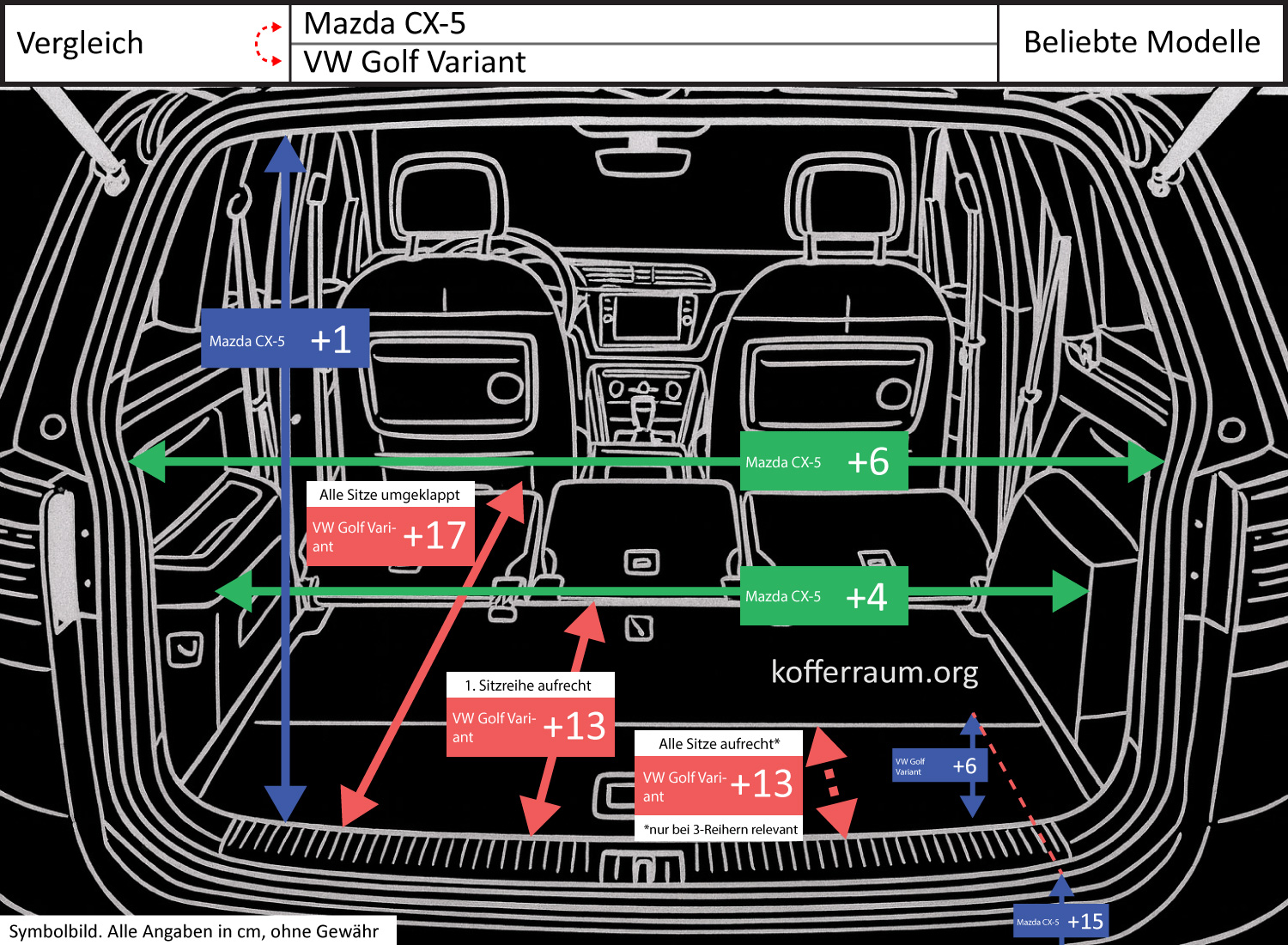
Key Differences (>10%)
When comparing, three significant differences stand out: The VW Golf Wagon offers a +5.1 in (≈14%) longer cargo space with the first row of seats upright compared to the Mazda CX-5. Additionally, the trunk depth (loading edge to trunk floor) in the Golf is +2.4 in (≈120%) greater, meaning it is significantly deeper than the CX-5. In contrast, the loading edge of the Mazda CX-5 sits +5.9 in (≈25%) higher above the ground than the Golf.
What impact do these differences have on usability?
The Golf’s +5.1 in longer cargo floor with the seats upright makes it more practical for everyday use with longer items that need to be transported without folding down the seats (e.g., long boxes, skis, furniture parts).
The greater depth of the Golf means the trunk extends further back, creating more usable volume — longer or bulky items can be stored flatter and more stably.
The higher loading edge of the Mazda (±5.9 in) increases physical strain when loading: heavier items must be lifted higher, making loading and unloading more difficult than with the deeper Golf trunk.
A higher loading edge can, however, offer slight protection when parking on uneven terrain or if the ground is wet, but it is primarily a disadvantage for handling heavy loads.
Smaller differences under 10%, which are less significant: The CX-5’s trunk opening is about 0.4 in higher, and the width at the narrowest point as well as the opening width are each a few centimeters larger on the CX-5. These advantages make it easier to maneuver wider but not very long items in and out, but do not change the fundamental superiority of the Golf’s deeper and longer cargo floor.