
Trunk comparison: Mazda Mazda CX-5 vs VW T-Roc

Key Differences
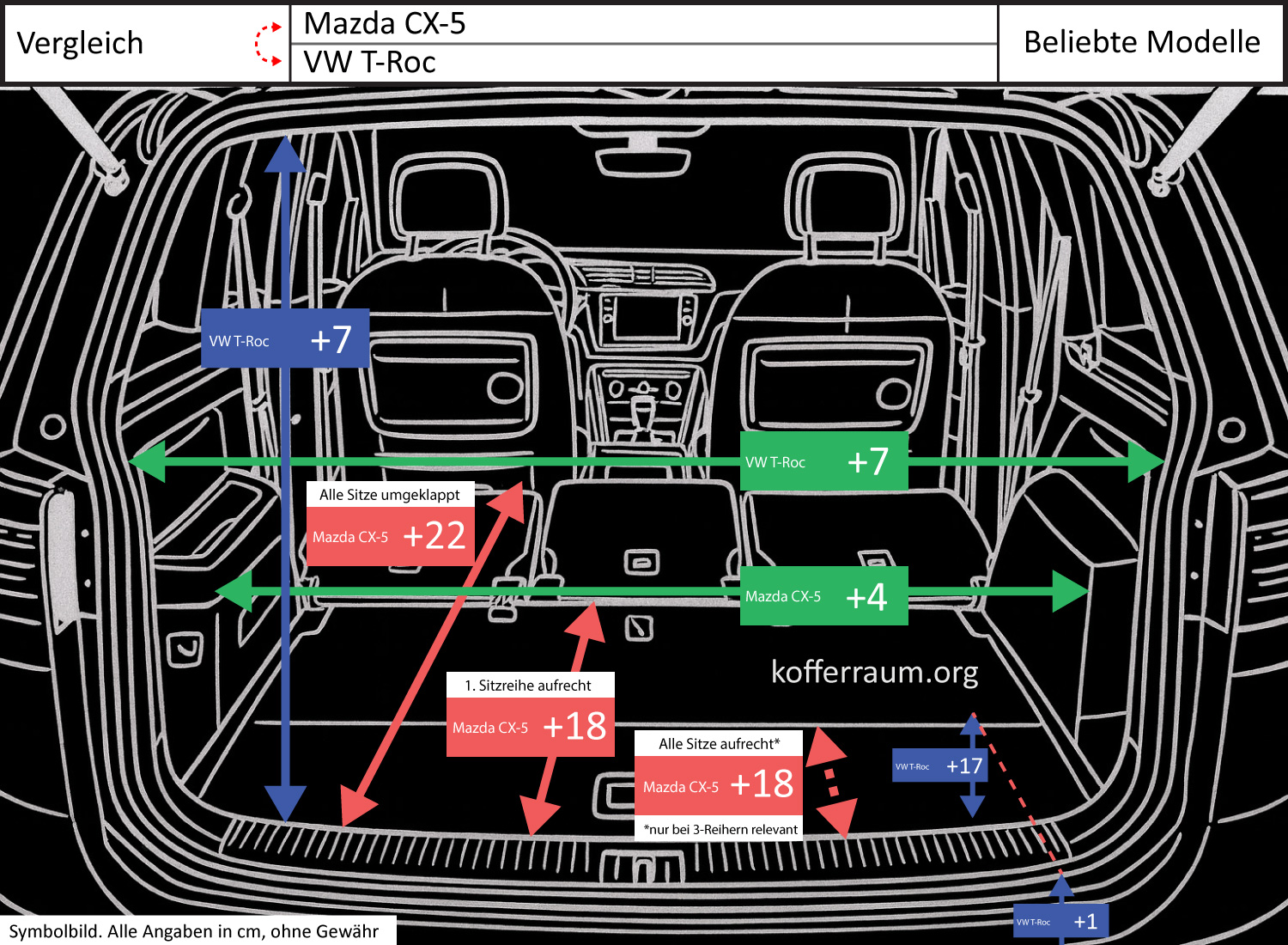
The Mazda CX‑5 offers a 8.7 in (≈15%) longer cargo space with the rear seats folded down than the VW T‑Roc; with the front seats upright, the advantage is even more pronounced: +7.1 in (≈23%). In contrast, the VW T‑Roc has a significantly greater depth between the loading edge and the trunk floor: +6.7 in (≈340%).
Other, smaller differences (under 10%) — not highlighted: the T‑Roc’s trunk opening is about 9% higher, the loading opening about 7% wider, the narrowest width in the Mazda about 4% larger, the T‑Roc’s loading edge about 1% higher.
What are the implications for usability?
The longer cargo space of the Mazda (both with folded seats and with the front seats upright) makes it more practical for long items like slats, boards, skis, or flat-packed furniture parts — less tilting or multi-level stowing needed, better use of length with a full cargo floor.
The greater depth of the T‑Roc (distance from loading edge to trunk floor) means the cargo area behind the loading edge is deeper.
Practically, this means more vertical space below the loading edge for stacked, tall boxes or hidden cargo, but also more lifting effort when loading heavy items and possibly less convenient loading of bulky, flat parts that need to be slid in lengthwise.
The slightly higher opening height and wider loading opening of the T‑Roc are minor advantages when loading very wide or tall items, but have less impact than the mentioned length and depth differences.
For users who regularly transport long, flat loads, the Mazda CX‑5 is the more practical choice; those who need more deep-space-typical, stacked cargo or a more vertical loading area benefit more from the T‑Roc.