
Trunk comparison: Tesla Model 3 vs VW Touran

Key Differences (marked: >10%)
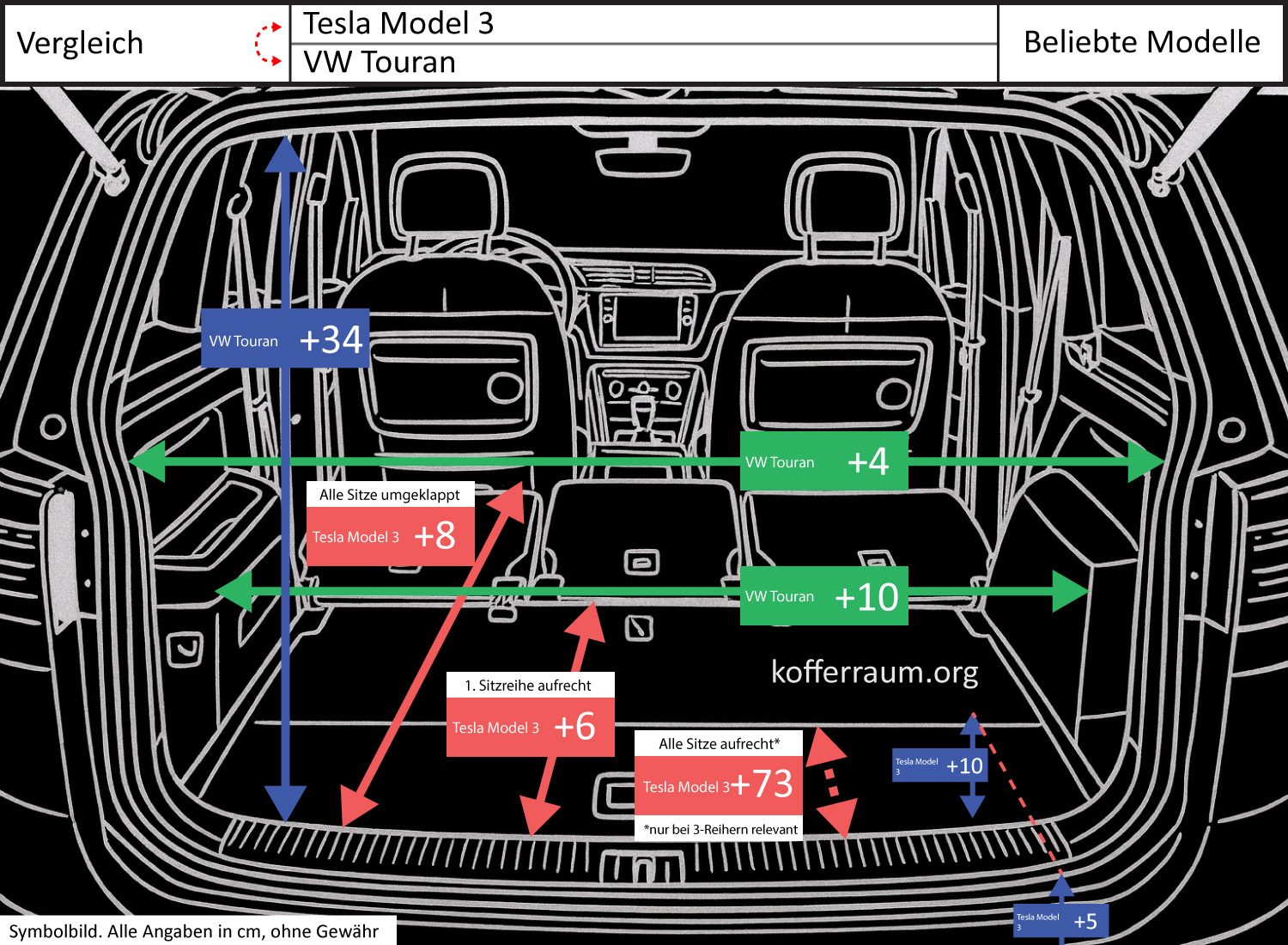
When comparing the cargo spaces, several major differences stand out: With all seats upright, the Tesla Model 3 offers a significantly longer cargo area than the VW Touran — +28.7 in (215%).
The height of the trunk opening is significantly greater in the Touran — +13.4 in (65%) compared to the Tesla. Additionally, the Tesla Model 3 has a considerably greater depth between the loading edge and trunk floor — +3.9 in (1000%).
Finally, the narrowest point of the trunk is wider in the Touran — +3.9 in (11%) than in the Tesla.
Smaller differences (under 10%) — e.g., Tesla +3.1 in with fully folded seats (4%), Tesla +2.4 in with front seats upright (6%), Tesla loading edge +2 in above the road (8%), and the slightly larger opening width of the Touran +1.6 in (4%) — exist but are less relevant in practice.
Impact on Usability
The significantly longer cargo area of the Tesla with seats upright (+28.7 in / 215%) makes it more practical for long items that need to be transported with full seating occupancy (e.g., skis, slats, long boxes) without folding down seat rows.
The greater depth in the Tesla (+3.9 in / 1000%) increases usable volume in the lower part of the trunk, making it well-suited for securely stowing bulky or low items; however, a deeper trunk floor can make lifting heavy loads during loading and unloading more difficult.
The higher trunk opening of the VW Touran (+13.4 in / 65%) provides more vertical space when loading and unloading: large, tall items can be inserted more easily, and handling bulky parts is more ergonomic.
The greater minimum width of the Touran (+3.9 in / 11%) means more room for wide luggage or crates; bulky widths are easier to accommodate in the Touran than in the Tesla.
In summary: For long, low, or deep loads with full seating occupancy, the Tesla Model 3 scores higher. For large volume in height, easier handling of tall items, and wider cargo pieces, the VW Touran is more advantageous. Smaller differences (under 10%) hardly affect everyday usability.