
Trunk comparison: VW Touran vs Durchschnitt Compact SUV


Main Differences
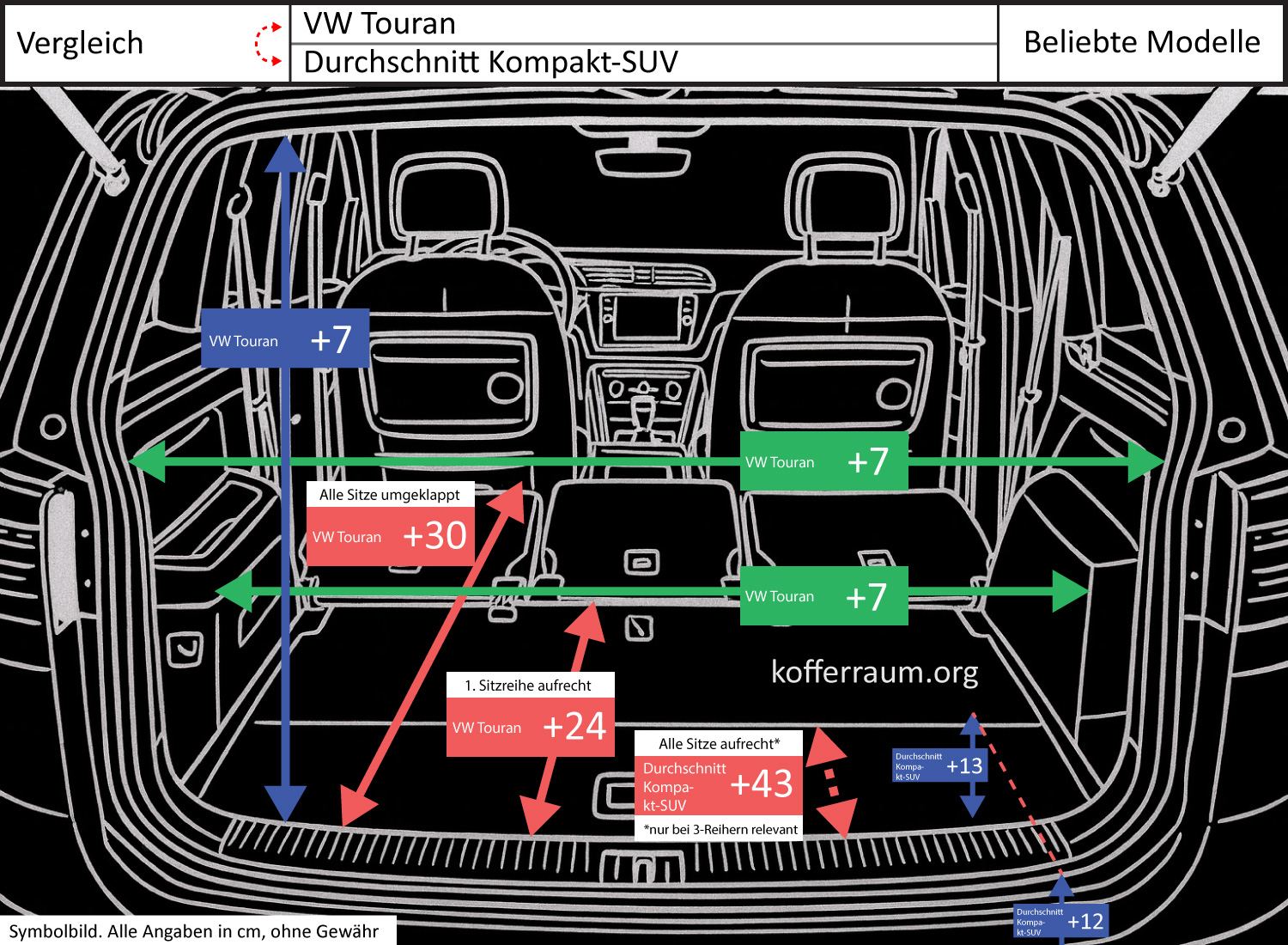
Some clear deviations stand out from the data: The VW Touran offers +11.8 in (≈20%) longer cargo space with folded seats and +9.4 in (≈31%) more loading length with the front row upright compared to the average compact SUV.
Conversely, the average compact SUV has +16.9 in (≈126%) larger trunk space with all seats in use than the Touran.
Furthermore, the depth (loading edge to trunk floor) is +5.1 in (≈1300%) greater in the average SUV and the loading edge is +4.7 in (≈19%) higher above the ground than in the Touran.
Smaller differences (under 10%) concern the height of the trunk opening (+9% in favor of the Touran) and the widths (+7%), which are not highlighted here.
What impact do these differences have on usability?
The strengths of the Touran lie in its versatility for long or bulky cargo: The significantly longer loading area with folded seats and with the front row folded forward allows furniture, boards, or bicycles to be accommodated more easily and lengthwise.
The lower loading edge makes it much easier to load heavy items because less lifting is required. Also, the slightly larger narrowest width and the wider opening (both just under 10%) support single-person loading of bulky parts.
The average compact SUV, on the other hand, is more practical in everyday use with full seating rows: It offers significantly more usable trunk space with all seats in use, making it better suited for families or trips where passengers and luggage need to be transported simultaneously.
The greater trunk depth also allows stacking or carrying taller items inside. A disadvantage is the higher loading edge: heavy luggage means more lifting effort or the need for a lift-assist device.
Conclusion: Those who frequently transport long or bulky cargo and value easy loading benefit from the Touran. Those who regularly travel with full seating rows and lots of luggage or need higher storage space in everyday life are better off with the average compact SUV.