
Trunk comparison: VW Touran vs Durchschnitt SUV


Key Differences
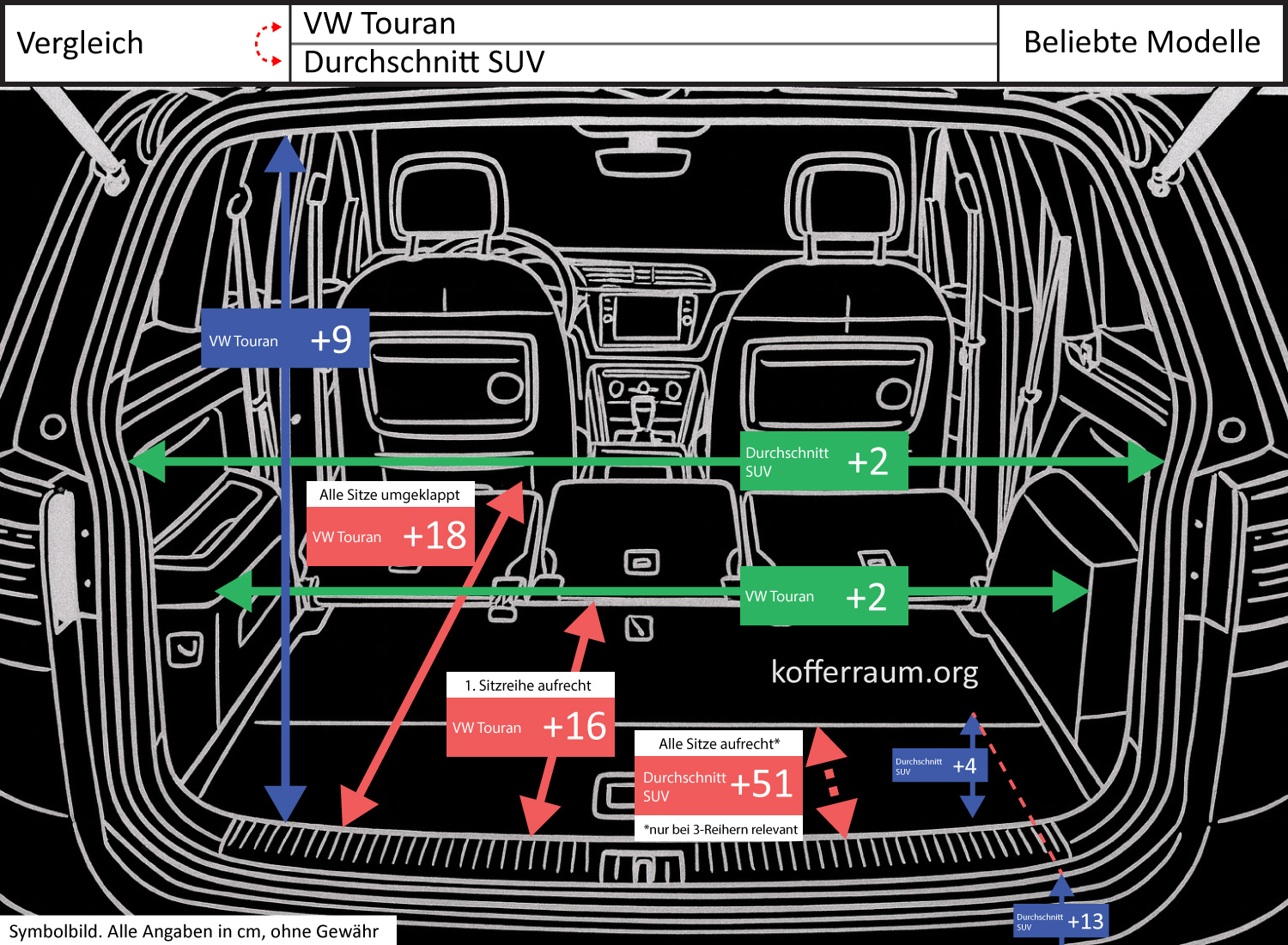
With the seats folded down, the VW Touran offers a cargo floor that is 7.1 in (≈11%) longer than the average SUV. With the first row of seats upright, the Touran remains 6.3 in (≈19%) longer — making it advantageous for transporting long items or flat loading.
In contrast, the average SUV has a trunk that is 20.1 in (≈150%) longer with all seats upright than the Touran, providing significantly more usable length when all seats are occupied.
The Touran's trunk opening is 3.5 in (≈12%) higher than the SUV's, which facilitates loading tall or bulky items. At the same time, the depth of the cargo area (loading edge to trunk floor) is 1.6 in (≈400%) greater in the average SUV, and the loading edge is overall 5.1 in (≈21%) higher above the ground.
The width differences (narrowest point +0.8 in in the Touran, opening width +0.8 in in the SUV) are each about ≈2% and thus negligible.
Implications for Practical Use
For users who frequently load long items, flat bulky goods, or heavy loads, the VW Touran is more practical: the greater length with folded or partially raised seats plus the higher opening reduce hassle when loading long parts and partly eliminate the need to lift over a high threshold.
Those who regularly travel with full seating occupancy and still want to carry a lot of luggage benefit from the SUV: the significantly longer cargo area with all seats upright means more storage space when fully occupied.
However, this comes with ergonomic drawbacks: the higher loading edge (+5.1 in) and the deeper trunk lead to more effort when loading and cause loaded items to sit deeper in the cargo area. This can make loading heavy items more difficult but is advantageous for volume.
In short: Touran = better handling and longer cargo floor for flat/low loads and easier handling. Average SUV = significantly larger trunk with full seating, but higher loading edge and deeper cargo area that complicate handling heavy or bulky loads.