
Home » Trunk dimensions » Smart
Smart — trunk dimensions
7 models
-
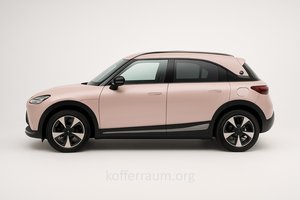 #1 Subcompact car
 -
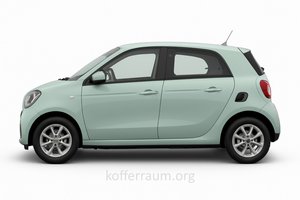 Forfour Subcompact car
 -
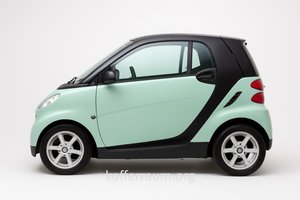 Fortwo Subcompact car
 -
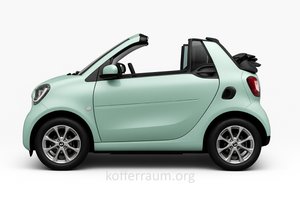 Fortwo Cabrio Convertible
 -
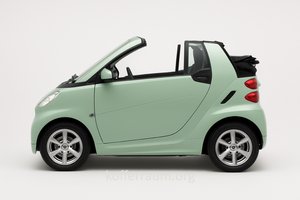 Fortwo Cabrio Electric Convertible
 -
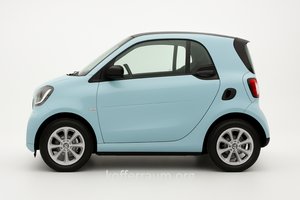 Fortwo Coupe Subcompact car
 -
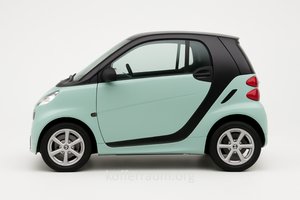 Fortwo Coupe Electric Subcompact car
About Smart
Smart is a brand that has redefined urban mobility. Since its inception in the 1990s, Smart has consistently followed the principle: less vehicle, more city. The brand made compactness its hallmark, combining it with a clear design philosophy, technical robustness, and a commitment to sustainability that is more important today than ever.
The first models – especially the Fortwo – had everything a city car needs: minimal exterior dimensions, low fuel consumption, surprisingly good crash ratings thanks to the visible safety cell (Tridion), and a distinctive, almost iconic design. The idea was not to make the conventional small car smaller, but to rethink a vehicle that focuses on the demands of urban everyday life: parking in tight spots, maneuverability in narrow streets, low operating costs, and easy handling.
Technically, Smart benefited for a long time from its proximity to established manufacturers. Components and safety concepts came from larger corporations, while Smart developed its own style and usage philosophies. Over the years, the brand expanded its portfolio with the Forfour and various special editions, experimented with different powertrain variants, and offered efficient small engines long before the big electric wave.
The truly decisive phase began with electrification. Smart was one of the first brands to radically shift to electric drive, sharpening its classic city profile: emission-free driving, reduced noise pollution, and deliberately limited ranges that are more than sufficient for inner-city use. Electric drives fit well with the brand’s DNA: they improve efficiency on short trips and make the vehicles ideal for sharing models and fleets.
Smart’s strengths clearly lie in urban expertise: compact exterior dimensions, easier handling, significantly lower operating costs, and strong brand recognition. The brand has acted with courage and wit in the market, giving it a unique identity. Additionally, electric Smart models open up new applications: carsharing, commuter trips, and as a second car in the big city are typical use cases.
Challenges include limited interior space and cargo capacity, as well as an image problem compared to larger, comfort-oriented cars. Pricing has also been an ongoing issue: for many buyers, a small car with a premium appearance is hard to justify. At the same time, competition from the electric market forces Smart to develop products quickly and maintain high technical quality.
Looking ahead: Smart is well positioned to evolve into a pure urban electric brand. The trend toward cities with increasing parking pressure, stricter emissions zones, and growing interest in sharing services plays into the brand’s hands. Technological advances in batteries, charging infrastructure, and connectivity can address many of the previous weaknesses, and it will be important for Smart to combine its core competence – compact, efficient, urban-oriented driving – with modern technology, attractive interiors, and convincing prices.
Conclusion: Smart is not a car in the traditional sense, but a concept for city mobility. The brand has proven that less can be not only different but often better — especially in the city. The challenge is to transfer this lead into the all-electric future while providing more practical solutions for everyday use and sharing. If successful, Smart will remain a relevant voice for urban mobility.