
Trunk comparison: Audi Q2 vs BMW 3 Series Touring
Key Differences
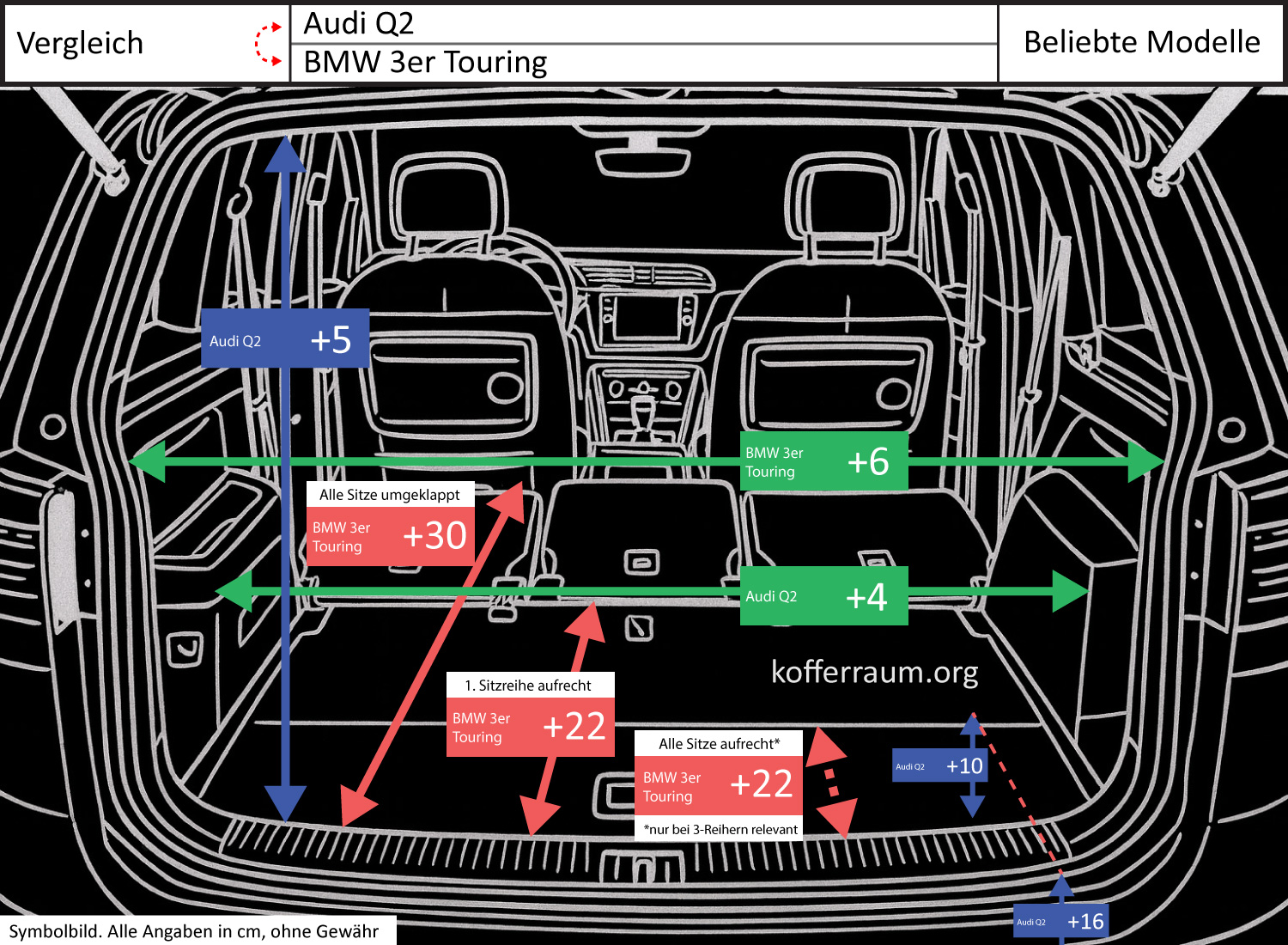
In terms of space, the BMW 3 Series Touring differs significantly from the Audi Q2: With the seats folded down, the BMW offers 11.8 in (21%) more length than the Q2, and with the rear seat upright, it is even 8.7 in (28%) longer.
The Audi Q2, on the other hand, has a significantly greater trunk depth between the loading edge and the floor — +3.9 in (1000%) — as well as a higher loading edge above the road surface by 6.3 in (27%).
Smaller differences under 10% include: the height of the trunk opening is 2 in (7%) higher in the Q2, the narrowest width of the trunk is 1.6 in (4%) larger in the Q2, and the opening width of the BMW is 2.4 in (6%) larger.
Impact on Usability
The greater loading length of the BMW makes it more practical for long items such as furniture, skis, or longer boxes — both with folded seats and in normal 5-seat operation.
This makes the BMW overall more flexible for transports where lengthwise extension matters. The lower loading edge of the BMW facilitates handling heavy or rolling luggage and loading/unloading bulky cargo.
The Audi Q2, by contrast, offers more "depth storage" due to the greater depth between the loading edge and the trunk floor: smaller luggage sits deeper and is less likely to slide out, and low items can be stored out of sight.
This feature can practically increase the cargo volume for everyday shopping or stacked, not too long items. However, the significantly higher loading edge makes lifting heavy loads into the Q2 more strenuous and less trunk-friendly.
In summary: Those who frequently carry long items or heavy luggage and need easy loading and unloading will benefit from the BMW 3 Series Touring.
Those who prefer to transport compact, stacked cargo securely and appreciate the deep trunk well may find the Audi Q2 advantageous — with the caveat that the higher loading edge complicates handling.