
Trunk comparison: BMW 3 Series Touring vs Mazda Mazda CX-5

Key Differences
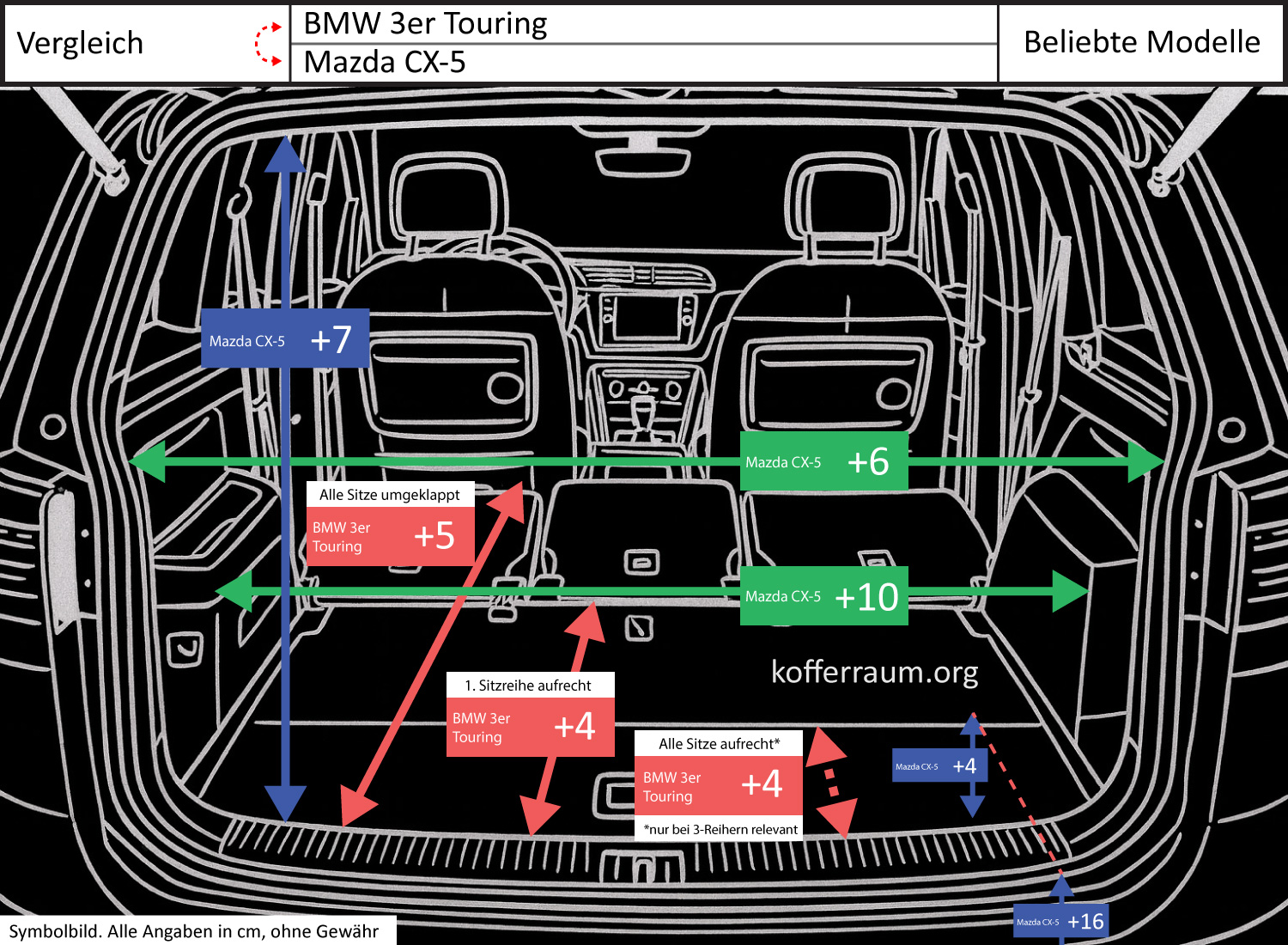
Three differences stand out clearly from the data: The depth of the trunk (loading edge → trunk floor) is +1.6 in (400%) larger in the Mazda CX‑5, the loading edge of the CX‑5 is +6.3 in (27%) higher above the road, and the width at the narrowest point is +3.9 in (11%) larger in the CX‑5. Smaller deviations exist in favor of the BMW regarding longitudinal storage space (+2 in / 3% folded down; +1.6 in / 4% with the first row upright).
The height of the trunk opening is +2.8 in (10%) larger in the CX‑5 and the opening width +2.4 in (6%), these values are moderate.
What are the implications for usability?
Higher loading edge in the CX‑5 (+6.3 in / 27%): A significantly higher loading level means more lifting work when loading and unloading heavy items (suitcases, groceries, tools).
Even with the larger interior recess, the trunk floor of the CX‑5 is still net higher above the roadway than in the BMW, which makes handling bulky or heavy loads more difficult.
Deeper trunk well in the CX‑5 (+1.6 in / 400% relative): The greater depth behind the loading edge creates more vertical space directly in the cargo area and more of a "well," so that small to medium-sized items sit more securely and are less likely to shift.
This is practical for beverage or grocery shopping and for stacking less sensitive cargo.
Wider narrowest width in the CX‑5 (+3.9 in / 11%): Wider bottlenecks mean that bulkier or wider parts (boxes, child seat bases, bulky shopping cartons) fit more easily through the trunk. Together with a slightly larger opening height, this facilitates transporting wide items.
Shorter but flatter solution in the BMW: The BMW 3 Series Touring offers slightly more usable length with the seats folded down, which somewhat favors loading longer, flat items (e.g., slats, long boxes).
Crucially, the loading edge in the BMW is significantly lower – this makes lifting heavy cargo easier and more comfortable in everyday use.
Conclusion: For frequent lifting of heavy loads and comfortable loading and unloading in daily life, the BMW 3 Series Touring is more practical due to the lower loading edge.
For transporting wider or bulkier items (more interior width, deeper well) and for secure holding of smaller cargo, the Mazda CX‑5 is better suited but carries the disadvantage of the higher loading edge.