
Trunk comparison: Kia Sportage vs Mazda Mazda CX-5


Key Differences
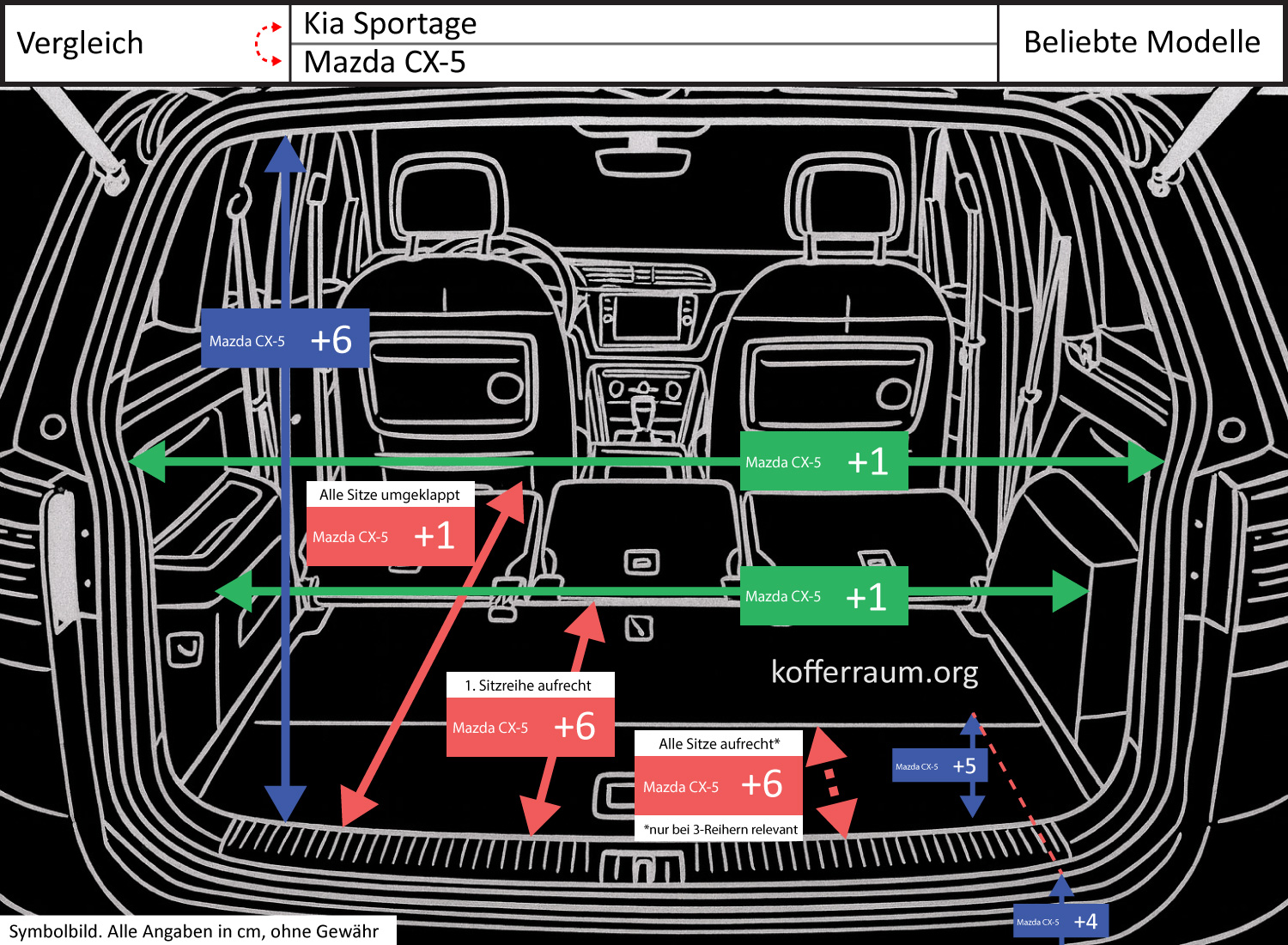
In most dimensions, the two models are very close: With the rear seats folded down, the Mazda offers only +0.4 in (1%) more loading length, with the front seats upright it is +2.4 in (7%) in favor of the Mazda, the trunk opening is +2.4 in (8%) higher, and the opening width as well as the narrowest trunk width are each +0.4 in (1%) larger.
However, noticeably and significantly larger is the depth of the trunk (loading edge to trunk floor): the Mazda CX‑5 has +2 in (400%) here compared to the Kia Sportage. Additionally, the loading edge of the Mazda is +1.6 in (6%) higher above the ground.
Implications for Usability
The significantly greater trunk depth in the Mazda means more usable vertical volume behind the loading edge.
Practically, this means: bulky or tall items can be fully and securely accommodated in the Mazda more easily, small items are less likely to disappear under the loading edge, and you gain headroom when stacking. The higher trunk opening (+2.4 in) further supports loading tall items.
On the other hand, the +1.6 in higher loading edge of the Mazda makes lifting heavy items into the trunk more difficult: Those who frequently load heavy cargo have a handling advantage with the Kia due to the lower loading edge.
The other differences in length and width are under 10% and are usually negligible in everyday use; they only result in minimal extra space for long luggage or slight leeway when stowing.
Conclusion: For transport tasks where vertical space and storing tall or bulky items are important, the Mazda CX‑5 is the more practical choice. If heavy loads need to be lifted frequently or loading and unloading should be more ergonomic, the Kia Sportage is advantageous due to the lower loading edge.