
Home » Trunk dimensions » Mazda
Mazda — trunk dimensions
14 models
-
 Mazda2 Subcompact car
 -
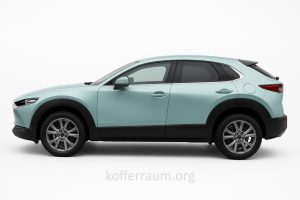 Mazda3 Compact car
 -
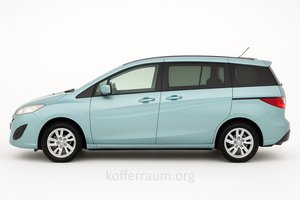 Mazda5 Minivan
 -
 Mazda6 Sedan
 -
 Mazda6 Wagon Wagon
 -
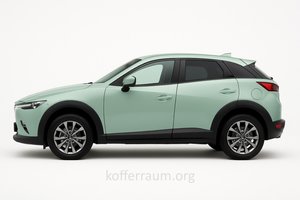 Mazda CX-3 SUV
 -
 Mazda CX-30 SUV
 -
 Mazda CX-5 SUV
 -
 Mazda CX-60 SUV
 -
 Mazda CX-7 SUV
 -
 Mazda CX-80 SUV
 -
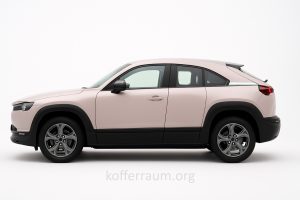 Mazda MX-30 SUV
 -
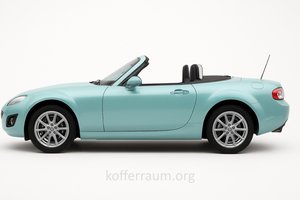 Mazda MX-5 Miata Convertible
 -
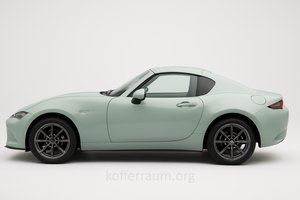 Mazda MX-5 Miata RF Coupe
About Mazda
Mazda is a brand that has maintained a clear profile in the automotive industry for decades: driver-focused, design-strong, and technically independent. Its roots go back to 1920, when Toyo Cork Kogyo was founded in Hiroshima. From this family business, a manufacturer evolved that continuously reinvented itself — without losing focus on the experience behind the wheel.
A particularly defining moment was Mazda's early decision to invest in Wankel rotary engine technology. With the Cosmo Sport in the late 1960s and later with icons like the RX-7, Mazda built a reputation as a pioneer of unconventional powertrain solutions. The highlight of this era was the overall victory at the 24 Hours of Le Mans in 1991 with the 787B – still today a symbol of technical courage and motorsport expertise.
Design is a second pillar of the brand. Under the name Kodo – "Soul of Motion" – Mazda has been shaping vehicles since around 2010 with sculptural surfaces, clear proportions, and an emotional, flowing design. Kodo aims to make movement and vitality visible even in a stationary vehicle. The interiors are consistently driver-centered: simplified controls, high-quality materials, and an atmosphere that meets customer expectations of craftsmanship.
Technically, Mazda has delivered its own answer to efficiency and driving dynamics with the Skyactiv philosophy. Skyactiv combines engines, transmissions, bodies, and chassis to reduce weight, increase efficiency, and still provide a direct, controlled driving feel. Instead of pure downsizing strategies, Mazda focused on optimized combustion, high compression, and overall lightweight-oriented solutions. The result: engines with good torque and comparatively low consumption, combined with chassis tuning that conveys the brand promise "Zoom-Zoom."
The model range reflects Mazda's self-image: compact, dynamic sedans and SUVs that offer more driving pleasure than just transport function. Bestselling models like the Mazda3 and the CX-5 are examples of how everyday usability and emotional design are combined. With the CX-90 and other newer models, Mazda also aims for higher market segments, with more space, power, and optional comfort features.
At the same time, Mazda faces the challenge of electrification. With the MX-30, the brand introduced its first fully electric model, while continuing to pursue a pragmatic path: hybrids, plug-in hybrids, and, if needed, range-extender configurations to meet customer needs in different markets. Collaborations with other manufacturers complement Mazda's own development without diluting its distinctive character.
Mazda thus remains a brand for people who value driving dynamics, design, and an independent technical identity. The combination of historical innovation — visible in the rotary engine history and motorsport successes — as well as the claim to form, quality, and efficiency makes Mazda a consistent alternative in the competitive environment. For buyers, this means vehicles that are deliberately thought differently, with a clear focus on what matters when driving.